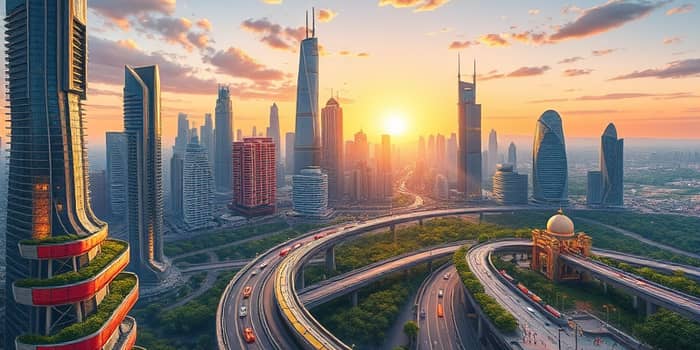
As the world approaches 2030, urban centers housing over 10 million people are poised to become the primary drivers of global economic growth. From emerging hubs in Africa to established powerhouses in Asia and North America, these megacities will shape the future of innovation, commerce, and human well-being.
The Rise of Global Megacities
In 2025, more than 12,000 cities worldwide support populations exceeding 50,000 inhabitants, collectively sheltering 45% of the planet’s 8.2 billion people. Megacities—those with over 10 million residents—have quadrupled since 1975, growing from just eight to thirty-three today.
- Number of megacities in 2025: 33 (19 in Asia)
- Projected by 2030: ~40 megacities; by 2050
- Leading regions: fast‐growing urban corridors in Africa and South Asia
These sprawling urban agglomerations concentrate talent, capital, and opportunities, forging powerful business ecosystems where productivity soars and innovations take root.
Economic Powerhouses and Sectoral Shifts
Metropolitan regions already account for a striking 94.3% of United States GDP growth, demonstrating urbanization’s profound economic impact. In cities like New York and London, service industries comprise nearly 90% of economic output, while emerging megacities such as Lagos reach 60% service contributions.
Services, finance, technology, and creative economies dominate urban growth, propelling research clusters, financial districts, and cultural quarters. As each city refines its specialization, global networks of exchange and collaboration become ever more intricate.
Future Projections: 2030–2070
Between 2025 and 2050, the world’s 1,000 largest cities will gain over 500 million residents, with existing megacities adding 266 million. Africa stands at the forefront of this wave: Dar es Salaam and Luanda will join Cairo and Lagos as some of the largest urban centers by 2050. In Asia-Pacific, Delhi’s metropolitan area could reach 47 million inhabitants.
These projections reflect shifting dynamics: strategic relocations for talent, affordable living costs, and expanding digital infrastructures.
Drivers of Growth: Technology, Policy, and Migration
Several forces underpin the rapid expansion and dynamism of megacities worldwide:
- Tech-enabled connectivity through high-speed rail, autonomous fleets, and 5G networks
- Pro-urban policy measures and foreign direct investment incentives
- Migration of educated professionals sustaining labor markets
- Emergence of circular economies and shared resource models
The synergy between innovation clusters, streamlined regulations, and global talent flows creates environments where businesses can thrive and adapt swiftly.
Challenges: Inequality, Sustainability, and Bubbles
Yet the ascent of megacities carries significant risks. Unchecked growth can trigger soaring housing costs, market bubbles, and deepening social divides.
- Skyrocketing property prices and potential real estate crises
- Widening income inequality, particularly in informal settlements
- Environmental pressures: pollution, resource scarcity, climate vulnerability
- Reliance on finite infrastructure, risking systemic failures
Addressing these issues requires foresight, resilient governance, and inclusive investment strategies.
Scenarios for 2060: Four Possible Futures
Experts outline four distinct pathways for megacities through 2060, each driven by varying social, economic, and policy choices:
Scenario 1: Epicenters of Global Economy—Rapid advances in education, productivity, and circular economies propel select megacities to outperform entire nations. By 2040, urban hubs in Asia, Africa, and South America lead global markets, pioneering green technologies and sustainable living.
Scenario 2: Mega-Slums—Neglected infrastructure and declining foreign investment spark sprawling informal settlements. By 2050, over 40 million residents live in substandard conditions, triggering public health, crime, and stability crises.
Scenario 3: Dysfunctional Artificial Cities—Aggressive construction without social safeguards leads to ghost towers, unemployment, and financial contagion. The collapse of speculative bubbles triggers a global downturn by 2032.
Scenario 4: Dispersal via Tech—Breakthroughs in remote work and ultra-fast transit diffuse growth into mid-sized cities. Networked urban regions share prosperity, reducing mega-concentration and fostering balanced regional development.
Charting a Sustainable Path Forward
To harness the promise of megacities while mitigating risks, policymakers and urban planners must embrace integrated urban and rural planning, prioritize affordable housing, and facilitate sustainable high-speed transport networks. Key strategies include:
- Implementing green building standards and renewable energy grids
- Expanding inclusive public transit and pedestrian-friendly zones
- Supporting social services and affordable housing initiatives
- Encouraging public-private partnerships for resilient infrastructure
By marrying innovation with equity and environmental stewardship, the megacities of tomorrow can become beacons of prosperity and well-being for billions.
As we stand on the brink of an unprecedented urban era, the choices we make today will determine whether megacities serve as engines of opportunity or sources of division. The path ahead demands vision, collaboration, and an unwavering commitment to an inclusive, sustainable future.
References
- https://www.futuresplatform.com/blog/scenarios-future-megacities-urbanisation
- https://milkeninstitute.org/content-hub/research-and-reports/research-and-data-tools/best-performing-cities-2026-resilience-cooling-economy
- https://info.siteselectiongroup.com/blog/the-rise-of-tomorrows-megacities-predicting-americas-urban-future
- https://www.oxfordeconomics.com/resource/rise-of-new-megacities-will-drive-global-urban-growth/
- https://www.statista.com/chart/15876/megacities-growth/
- https://europeansting.com/2025/11/19/cities-now-home-to-nearly-half-of-humanity-un-report/