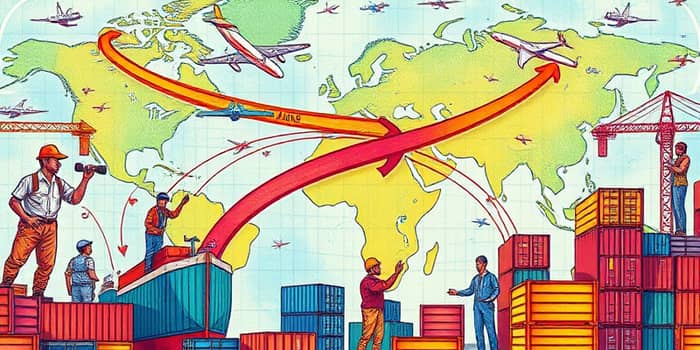
The global economy faces an inflection point as nations navigate a renewed era of protectionism. Policies enacted in 2025 have reshaped trade flows, supply chains, and geopolitical alliances, leaving businesses and policymakers racing to adapt.
This article delves into the roots of the latest tariff escalations, examines their broad economic impacts, and offers practical guidance for stakeholders aiming to build resilience.
Historical Prelude: 2017–2024 Trade Tensions
Trade conflicts between the United States and China since 2017 prompted firms to reorient manufacturing toward Southeast Asia, Mexico, and other regions. This strategic shift laid the foundation for the disruptions that unfolded in 2025.
In those years, Chinese exporters absorbed cumulative tariffs exceeding 25 percent, spurring lengthened supply chains increasing disruption risks and driving investments in alternative hubs.
2025 Tariff Timeline: A Year of Escalations
Beginning in early 2025, the U.S. administration announced a series of sweeping tariff measures aimed at bolstering domestic industries. Each announcement ratcheted up uncertainty and forced businesses to make critical supply decisions under immense pressure.
- February 10, 2025: 25% tariffs on steel and aluminum imports from all countries, effective March 12.
- March 7, 2025: Threat of 250% reciprocal tariffs on Canadian lumber and dairy unless Canada rescinded its high dairy duties.
- April 2, 2025: Broad reciprocal tariffs announced on all trading partners, including potential auto tariffs designed to challenge Canadian manufacturing.
- April 8, 2025: Executive order ending de minimis exemptions for Chinese goods, rising to 90% ad valorem or $150 per item.
- Peak tariffs on China reached as high as 145% on select products.
These actions triggered pre-emptive import frontloading, with many firms importing critical inputs in late 2024 to avoid higher duties.
Economic and Social Repercussions
The tariff surge reshaped trade balances and consumer prices, while sending shockwaves through employment and inflation metrics. Policymakers and businesses scrambled to gauge short- and long-term effects.
- Imports/Exports: U.S. imports from China plunged, while Chinese suppliers redirected exports to Brazil and Southeast Asia.
- Employment Shifts: Early 2025 saw 85% of manufacturing job gains before April, followed by layoffs in high-tariff sectors.
- Inflationary Pressure: Core PCE rose by 0.5 percentage points, reversing previous cooling trends.
- GDP Growth Drag: Exports and imports contributed less to U.S. GDP growth in 2026 versus 2025.
- Tech Sector Strain: Hardware costs jumped, logistics expenses climbed 10–15%, and supply delays emerged.
- Unemployment-Inflation Link: Both rose together for the first time since the 1970s.
As inventories were depleted, producer prices began ticking up, and a weaker dollar amplified imported inflationary pressures.
Forecasting the Future: 2026–2027 Outlook
Analysts project the U.S. effective tariff rate will peak near 13 percent in early 2026, sustaining elevated costs across multiple sectors. Harried firms continue lobbying for carve-outs, while governments signal potential new measures under national security authorities.
Supply chains remain under stress, with diversification ongoing toward Mexico, India, and Eastern Europe. Yet, the trend of peak effective tariff rate near thirteen percent underscores persistent protectionist momentum.
Strategies for Adaptation and Resilience
Businesses can navigate this volatile environment by rethinking procurement, logistics, and financial planning. A proactive approach helps mitigate cost shocks and maintain competitiveness.
- Supply Chain Diversification: Source inputs from multiple regions to reduce dependence on any single country.
- Dynamic Inventory Management: Use just-in-case stockpiles balanced with just-in-time efficiencies.
- Tariff Engineering: Reclassify processed goods or adjust product specifications to qualify for exemptions.
- Hedging and Financing: Lock in currency and commodity prices to cushion against sudden cost spikes.
- Stakeholder Engagement: Work with trade associations and policymakers to advocate for sensible exemptions.
Implementing these strategies for supply chain diversification and resilience can safeguard operations against further disruptions.
Global Dynamics and Diplomatic Pathways
Amid tit-for-tat escalations, multilateral institutions like the WTO play a vital role in mediating disputes. Trading partners are exploring new alliances and agreements to offset restrictive U.S. policies.
Countries such as Canada and Mexico have threatened reciprocal measures on dairy, lumber, and autos, while the EU and Turkey have enacted barriers targeting Chinese imports. Cooperative frameworks offer an alternative pathway, emphasizing united diplomatic efforts through multilateral institutions to stabilize markets.
Conclusion: Charting a Path Through Uncertainty
The trade wars of 2025–26 illustrate how swiftly policy shifts can reshape the global economic landscape. Yet, they also highlight the incredible agility and creativity of businesses and governments that adapt.
By embracing resilience strategies, fostering strategic partnerships, and advocating for balanced trade policies, stakeholders can transform uncertainty into opportunity. The path forward requires vision, collaboration, and an unwavering commitment to innovation.
References
- https://kpmg.com/us/en/articles/2026/global-trade-outlook-2026.html
- https://tecex.com/us-tariffs-2025-2026/
- https://en.wikipedia.org/wiki/2025%E2%80%932026_United_States_trade_war_with_Canada_and_Mexico
- https://www.tradecomplianceresourcehub.com/2026/02/12/trump-2-0-tariff-tracker/
- https://cepr.org/voxeu/columns/update-great-reallocation-us-supply-chain-trade
- https://www.piie.com/blogs/realtime-economics/2026/trumps-trade-war-wrecked-little-havoc-trade-patterns-last-year
- https://gmk.center/en/posts/trade-wars-how-trumps-factor-affects-the-global-economy/
- https://www.jpmorgan.com/insights/global-research/current-events/us-tariffs