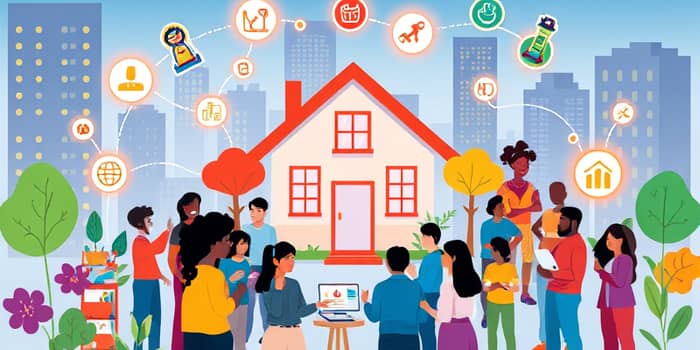
The rise of the sharing economy marks a profound shift in how we access and consume goods and services. Where once ownership defined value, now excess capacity rather than ownership fuels new opportunities. Digital platforms unlock the potential of idle assets, enabling individuals to transform spare rooms, cars, and skills into income streams. This collaborative consumption model reimagines economic relationships and empowers communities to optimize resources, reduce waste, and foster trust.
Origins and Technological Drivers
The origins of the sharing economy trace back to early peer-to-peer exchanges, but only with the advent of big data and powerful online platforms did this model soar. Big data, online platforms, digitalization converged to streamline transactions, while real-time tracking and microtransactions ensured seamless user experiences. Secure payment systems and user ratings cultivated trusted community accountability via user ratings. Innovations like blockchain now promise enhanced security and transparency, further solidifying the foundation for collaborative consumption.
Airbnb and Uber exemplified rapid growth by enabling users to monetize idle assets. As these platforms scaled, they demonstrated how technology can bridge supply and demand in real time, turning personal resources into globally accessible services. This transformation of idle capacity into economic value underpins the sharing economy’s success and sustainability.
Market Growth and Sectoral Expansion
Global projections illustrate staggering growth: from $14 billion in 2014 to an estimated $335 billion by 2025. Technavio forecasts an additional $1.12 trillion from 2025 to 2029, driven by ride-hailing convenience and blockchain integration. In China alone, the sharing economy reached 3.83 trillion yuan in 2022, spanning domestic services, knowledge sharing, and co-working spaces. EU short-stay accommodations recorded over 366 million guest nights in Q3 2024, up 18% year-on-year.
This expansion highlights how new business models and increased competition reshape traditional industries. Established sectors adapt by embracing sharing principles, while startups innovate specialized services. The proliferation of niche platforms—from peer-to-peer lenders to tool-sharing networks—demonstrates the model’s versatility and resilience.
Economic Advantages and Social Impacts
The sharing economy delivers diverse economic benefits, optimizing resource use and unlocking hidden value. By turning underutilized assets into revenue, individuals become microentrepreneurs, reshaping local economies and fostering transforming passive consumers into active entrepreneurs. The environmental impact is equally profound, as resource optimization reduces waste and carbon emissions.
- Cost-effectiveness: Access replaces ownership, lowering user expenses.
- Revenue generation: Owners monetize idle assets like spare rooms and vehicles.
- Resource efficiency: Platforms optimize allocation and reduce waste.
- Job creation: Gig opportunities diversify income sources for individuals.
- Sustainability: Shared use promotes reuse and environmental stewardship.
Beyond economics, the sharing economy fosters social connections. Peer-to-peer activities of obtaining and offering services build communities of trust. Ratings and reviews cultivate a sense of accountability, encouraging responsible behavior and reciprocity among participants.
Challenges and Regulatory Considerations
Despite its benefits, the sharing economy faces challenges. Regulatory frameworks often lag behind rapid innovation, creating tension between traditional industries and pioneering platforms. Issues around labor rights, safety standards, and competition require coherent policies. Balancing entrepreneurial freedom with consumer protection has become a pressing task for policymakers.
- Regulatory gaps: Inconsistent rules across jurisdictions hinder growth.
- Worker protections: Gig workers often lack benefits and job security.
- Privacy and security: Data breaches and misuse pose risks to users.
- Market disruption: Traditional businesses face declining demand and revenue.
Furthermore, privacy concerns and complex operational chains can erode consumer trust. Platforms must invest in robust security measures and transparent practices to sustain user engagement and safeguard reputations.
Future Outlook: Innovation and Policy
Looking ahead, the sharing economy will likely become more integrated into everyday life. Advanced AI, IoT devices, and blockchain will refine trust mechanisms and streamline transactions. Emerging sectors—such as decentralized energy sharing and peer-to-peer healthcare consulting—hint at boundless possibilities.
However, realizing this potential demands thoughtful policy frameworks that protect stakeholders without stifling innovation. Governments should collaborate with industry leaders to develop regulations that encourage balancing innovation with regulation and ensure equitable competition. Supporting international entrepreneurship and addressing social equity concerns will be critical to sustaining growth.
Ultimately, the sharing economy represents more than an economic model; it embodies a cultural shift toward collaboration, sustainability, and empowerment. By harnessing technology to match supply with demand, we can build resilient communities, drive sustainable development, and unlock new frontiers of value creation. As we continue to refine and regulate this model, the sharing economy will stand as a testament to human ingenuity and collective progress.
References
- https://www.brookings.edu/articles/the-current-and-future-state-of-the-sharing-economy/
- https://etedge-insights.com/industry/e-commerce/rise-of-collaborative-consumption-and-sharing-economy/
- https://en.wikipedia.org/wiki/Sharing_economy
- https://corporatefinanceinstitute.com/resources/economics/sharing-economy/
- https://internationalbanker.com/finance/strong-growth-ahead-expected-for-the-sharing-economy/
- https://pmc.ncbi.nlm.nih.gov/articles/PMC9483470/
- https://www.pewresearch.org/short-reads/2016/05/20/how-americans-define-the-sharing-economy/
- https://www.masterclass.com/articles/sharing-economy
- https://www.imergey.com/insights/shared-economy-collaborative-consumption-and-rewriting-the-rules-of-ownership/
- https://trendsresearch.org/insight/sharing-economy-the-future-of-the-global-economy/
- https://journals.plos.org/plosone/article?id=10.1371%2Fjournal.pone.0309024