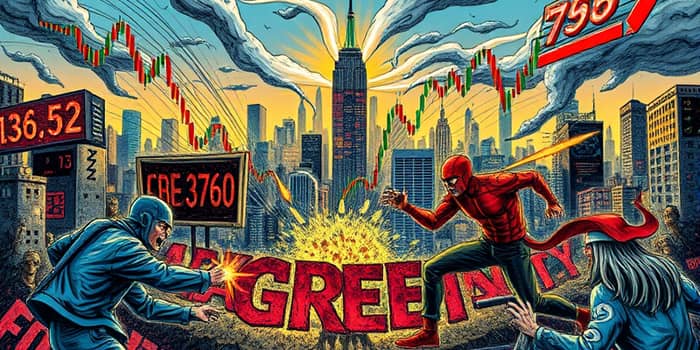
In the complex world of financial markets, two primal emotions dictate the ebb and flow of prices and investor behavior. Fear compels market participants to sell at the worst possible moment, while greed fuels exuberant buying that often ignores underlying value. Recognizing and mastering these forces can distinguish a successful investor from one who falls prey to volatility and irrational swings.
This article delves deep into the origins, expressions, and management of fear and greed across global markets. Drawing on psychology, neuroscience, and historical episodes, it provides a comprehensive guide to navigate emotional extremes, build resilience, and harness market cycles for enduring wealth creation.
Core Concepts and Definitions
At the heart of market dynamics lies the tension between fear and greed. John Maynard Keynes famously coined the term animal spirits identified by Keynes to describe the human emotions that sway economic decisions, often overpowering rational analysis. Traditional finance models like the efficient-market hypothesis assume that prices quickly adjust to new information, yet real-world trading is frequently marred by behavioral anomalies.
Warren Buffett’s mantra—“be fearful when others are greedy and greedy when others are fearful”—serves as a timeless reminder to adopt a contrarian stance. The market capitalization-to-GDP ratio, popularly known as the Buffett indicator, alerts investors to potential overvaluation when markets climb too far above national economic output. Conversely, steep market declines relative to GDP often signal attractive entry points.
While greed drives profit-chasing momentum, fear enforces risk aversion and security seeking. Understanding these dual impulses is crucial not only for pinpointing market extremes but also for crafting strategies that anticipate emotional turning points rather than react to them.
Psychological Mechanisms at Play
Fear is rooted in loss aversion—the psychological phenomenon where pain of losses felt more intensely than equivalent gains. Neuroeconomic studies show that the amygdala, responsible for threat detection, triggers fast, automatic responses that can override the deliberative functions of the prefrontal cortex. Investors under stress may experience heightened anxiety, prompting them to abandon long-term plans in favor of immediate safety.
- Loss aversion: Investors cling to losing positions, hoping for a rebound, often deepening losses over time.
- Panic selling: Sudden market shocks can trigger a rush to exit, producing cascading declines and liquidity crises.
- Fear of missing out (FOMO): As prices ascend, many become desperate to join the rally, often buying at inflated levels.
On the flip side, greed activates reward circuits in the brain much like addictive substances, reinforcing behavior that chases ever-higher returns. The prospect of outsized gains drives speculative bubbles, where fundamentals are sidelined in favor of momentum. Psychologist Lola Lopes highlights that hope often underpins greed, as investors fixate on potential upside rather than realistic outcomes.
Both fear and greed are magnified by herd mentality, where individuals follow crowd behavior, amplifying market trends beyond reasonable bounds. Recognizing these biases and understanding the undercurrents of group psychology can help investors break free from collective hysteria.
Historical Market Examples
Exploring past market cycles reveals how emotional extremes have shaped financial booms and busts. From the dot-com era through the financial crisis to the cryptocurrency surges, fear and greed have alternately driven investors to irrational highs and debilitating lows.
Each case illustrates how emotional overreactions can derail markets, often taking years to correct. Investors who remained disciplined during these cycles, frequently using Buffett’s contrarian wisdom on timing markets, were able to capture outsized gains when sentiment normalized.
Key Indicators and Metrics
- VIX (Volatility Index): Known as the “fear gauge,” high readings suggest panic, while low levels imply complacency.
- Buffett Indicator: Total market cap-to-GDP ratio that flags extremes in valuation relative to economic output.
- Neuroscientific measures: Studies link emotional arousal to trading volume, revealing quantifiable effects of mood on market actions.
- Margin debt levels: Elevated borrowing for speculation can portend heightened risk of sharp reversals.
By monitoring these indicators, investors can better detect when markets deviate from fundamental drivers and prepare accordingly. Combining quantitative data with behavioral awareness offers a robust framework for decision making.
Strategies to Manage Fear and Greed
To navigate emotional volatility, investors must build disciplined systems that hedge against emotional decision making and reinforce consistent actions under stress.
- Assess risk tolerance: Determine capacity for drawdowns and set allocation limits that match personal comfort levels.
- Use dollar-cost averaging: Deploy capital over time to mitigate the impact of market timing and price spikes.
- Establish profit and loss rules: Predefine entry and exit points, then adhere strictly to these guidelines.
- Diversify holdings: Spread investments across asset classes, sectors, and geographies to reduce reliance on one market.
- Avoid overleveraging: Limit borrowed capital to prevent forced liquidations during downturns.
- Stay informed, not overexposed: Consume select financial data without succumbing to every headline or social media hype.
Implementing self-awareness discipline and structured approaches helps maintain composure, allowing investors to capitalize on market dislocations rather than be overwhelmed by them.
Neuroscience and Emotional Primacy
Research in behavioral finance and neuroscience underscores the dominance of emotion over cognition. The amygdala’s rapid threat signaling can eclipse the prefrontal cortex’s capacity for planned decision making, leading traders to react instinctively to price movements. Recognizing this neural interplay is the first step toward building mental resilience.
Techniques such as mindfulness meditation, stress management, and reflective journaling can strengthen cognitive control, enabling more balanced responses to market stressors. Viewing investment through the lens of long-term goals rather than short-term wins fosters a mindset that long-term horizon perspective for disciplined investors thrives under, rather than buckles from, volatility.
Embracing Market Cycles for Long-Term Success
Markets are inherently cyclical, shaped by recurring patterns of fear and greed. Rather than resist these cycles, forward-thinking investors learn to anticipate and leverage them. Buying quality assets during widespread fear and trimming exposures when greed peaks can compound wealth dramatically over multi-decade horizons.
Patience and conviction stand as the cornerstones of this approach. Investors who develop confidence in their research and trust their systems find that emotional extremes transform from obstacles into opportunities.
Conclusion
Fear and greed will always pulse through global markets, but they need not determine individual outcomes. By understanding the psychological drivers, tracking key metrics, and implementing disciplined strategies, investors can position themselves advantageously. Through perseverance and contrarian insight, these potent emotions can be harnessed to fuel, rather than derail, a path to financial success.
Embrace the market’s emotional dance, remain steadfast in your plan, and let rational frameworks guide you toward lasting prosperity.
References
- https://in.snhu.edu/blogs/understanding-psychology-of-financial-markets
- https://en.wikipedia.org/wiki/Greed_and_fear
- https://www.nbkwealth.com/corporate-information/media-center/press-releases/NBK-Wealth-Thought-Leadership-The-Psychology-of-Investing-Managing-Fear-and-Greed
- https://westfincorp.com/mastering-the-psychology-of-investing-managing-fear-and-greed/
- https://www.ig.com/ae/master-your-trading-mind/managing-emotions/how-to-manage-fear-and-greed-in-trading
- https://www.gmo.com/americas/research-library/memo-to-the-virtual-investment-committee-ii-fear-and-the-psychology-of-bear-markets_whitepaper/