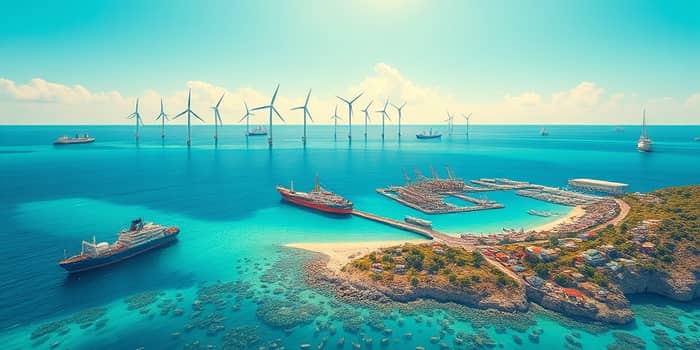
Oceans cover over 70% of our planet, driving critical ecosystems and global prosperity. From the bustling harbors of major ports to the gentle ebb of coastal tourism, the marine realm generates trillions in economic value annually. In an era of climate urgency and resource scarcity, the ocean economy offers one of the most compelling frontiers for growth, sustainability, and innovation.
As nations seek new pathways for development, understanding how to harness and protect this vast resource base becomes paramount. By exploring insights into market scale, sectoral contributions, employment dynamics, environmental challenges, and investment opportunities, stakeholders can chart a course toward inclusive blue growth that benefits communities and ecosystems alike.
Economic Scale and Growth Trajectory
Valued at approximately $3 trillion annually, the ocean economy represents close to 5% of global GDP. Between 1995 and today, this sector has experienced growing 2.5 times since 1995, significantly outpacing overall economic expansion. Projections suggest the market will reach—or even exceed—$3 trillion by 2030, driven by rising demand for marine-based goods and services.
In the United States alone, the marine economy contributed $511 billion to GDP in 2023, reflecting robust growth in sales and output. This trajectory underscores the ocean’s potential as a strategic asset for national economies, especially when framed within modern sustainability agendas that balance growth and preservation.
Key Sectors Driving Blue Growth
The ocean economy encompasses a diverse array of industries, each contributing unique value streams and employment opportunities. From traditional fisheries to cutting-edge marine technology, these sectors collectively shape resilience and competitiveness.
- Tourism and recreation: $225 billion in annual sales, buoyed by coastal destinations worldwide
- Shipping and maritime transport: handling over 80% of global trade by volume
- Fisheries and aquaculture: sustaining more than 3 billion people through food supply
- Offshore wind energy: experiencing over 1,000% growth in the EU since 2013
- High-tech manufacturing: growing 16% of ocean trade, from pharmaceuticals to marine robotics
Emerging areas such as offshore wind and marine renewable energy are attracting unprecedented levels of funding. In 2022, global investment in marine renewables reached €48.5 billion, accounting for more than half of worldwide renewable energy expenditure.
By adopting a sustainable use of ocean resources model, industry leaders and policymakers can ensure these sectors flourish while preserving marine biodiversity and ecosystem health for future generations.
Employment, Livelihoods, and Trade Dynamics
Oceans underpin millions of livelihoods across the globe. From artisanal fishers in coastal villages to engineers in high-tech shipyards, marine activities support diverse career paths and community well-being.
- more than 600 million jobs supported by ocean-related industries worldwide
- Over 3 billion people relying on marine resources for food and income
- 4.82 million employed in the EU blue economy as of 2022
- Average U.S. marine economy salary: $85,000 per year
- Shipping trade reaching record highs, with 11 billion tons of goods moved annually
Trade in ocean goods and services surged to $899 billion and $1.3 trillion respectively in 2023, reflecting a rapid increase in South–South exchanges. Small island developing states have seen per capita ocean exports reach $2,600, nearly ten times the global average.
Environmental and Sustainability Challenges
Despite its vast potential, the ocean economy faces pressing threats from pollution, climate change, and habitat degradation. Effective governance and innovation are essential to reconcile growth with conservation.
Every year, two million tons of plastic waste enter the ocean, endangering marine species and human health. Shipping decarbonization alone will require up to $28 billion annually, plus substantial investments in low-carbon fuels and port infrastructure.
- Up to two-thirds of marine species remain unidentified, underscoring knowledge gaps
- Annual decarbonization costs for shipping estimated at $8–$28 billion
- Developing economies face hurdles in financing sustainable transitions
Encouragingly, the EU has reduced maritime emissions per tonne-kilometer by 10% and cut CO₂ from its fishing fleet by 31% since 2009, demonstrating the power of coordinated policy and industry commitment.
Valuing Marine Ecosystem Services
Beyond direct market transactions, marine ecosystems deliver invaluable services often absent from traditional accounting frameworks. Coastal wetlands filter pollutants, coral reefs buffer storm surges, and open-ocean phytoplankton regulate the global climate.
These services are estimated at $24 trillion annually, with coral reefs alone generating $36 billion in tourism, fisheries, and storm protection. Recognizing this natural capital is vital for designing policies that internalize the full costs and benefits of ocean-based activities and safeguard resilience.
Investment, Innovation, and Future Potential
Strategic investments in research, infrastructure, and capacity building can amplify market returns and environmental outcomes. Studies indicate that transitioning to a sustainable ocean economy could yield $8.2–$22.8 trillion in net benefits by 2050, with a 400–615% return on investment.
Innovations in aquaculture, marine biotech, and renewable energy are attracting fresh capital inflows. Since 2018, funding for blue economy startups has grown steadily, driven by both public and private sector commitments to climate neutrality and coastal resilience.
By leveraging cutting-edge technologies and fostering cross-sector partnerships, stakeholders can unlock new value chains while preserving vital habitats and marine biodiversity.
As global populations grow and climate impacts intensify, the ocean economy stands at a critical crossroads. Embracing innovative governance, targeted investments, and inclusive policy frameworks will determine whether we realize the promise of blue growth. Together, we can write the next chapter in the story of our seas—one where economic prosperity and environmental stewardship sail in harmony.
References
- https://unctad.org/news/ocean-economy-booming-how-long
- https://unctad.org/news/fast-growing-trillion-dollar-ocean-economy-goes-beyond-fishing-and-shipping
- https://www.lse.ac.uk/granthaminstitute/explainers/what-is-the-blue-economy/
- https://seasyourdreams.org/role-of-oceans-in-the-global-economy/
- https://coast.noaa.gov/states/fast-facts/marine-economy.html
- https://www.un.org/en/desa/sustainable-blue-economy-vital-small-countries-and-coastal-populations
- https://www.bea.gov/data/special-topics/marine-economy
- https://blue-economy-observatory.ec.europa.eu/news/eu-blue-economy-report-2025-2025-05-22_en
- https://www.oecd.org/en/publications/2025/03/the-ocean-economy-to-2050_e3f6a132.html
- https://www.congress.gov/crs-product/IF12188
- https://www.worldbank.org/en/topic/oceans-fisheries-and-coastal-economies