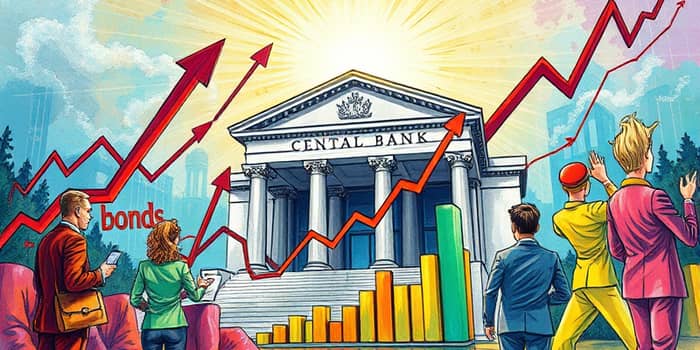
The sweeping influence of interest rates reverberates across financial markets, shaping the performance of bond and stock funds alike. Understanding this dynamic can empower investors to navigate volatility with confidence.
Understanding the Core Relationship
Central bank policy decisions play a pivotal role in fund performance. When authorities adjust benchmark rates, they aim to balance economic growth and inflation management. Lower rates stimulate borrowing and spending, driving investors toward higher-return instruments, while higher rates cool the economy.
The fundamental principle at play is the inverse bond price-interest rate relationship. As benchmark yields rise, existing bonds with lower coupons lose appeal, causing their market prices to decline. Conversely, falling rates boost the value of older bonds, lifting the Net Asset Value of bond funds.
Impact on Bond Funds
Bond funds experience the most direct effects of rate changes. A crucial measure is duration risk, which quantifies sensitivity to rate shifts. Funds with longer durations see more pronounced price swings, while short-term portfolios remain relatively stable.
- Long-term bond funds (maturities over 10 years) face the steepest price declines when rates rise.
- Intermediate-term bond funds (5–10 year maturities) offer a middle ground in volatility and yield.
- Short-term bond funds (1–3 year maturities) deliver price stability but limited yield increases.
- Floating rate funds and bank loan funds adjust income distributions upward as rates climb.
While rising rates depress bond prices, they also enhance income yields on new issuances. Over the long run, reinvestment of matured proceeds at higher prevailing rates can bolster overall bond portfolio returns.
Effects on Stock Funds
Interest rate shifts also influence equity valuations. Higher rates may prompt investors to reallocate from stocks to fixed income, as newly issued bonds offer competitive yields. Yet, stock performance depends heavily on corporate earnings and sectoral trends.
- Growth stock funds can thrive in rising rate environments if earnings accelerate faster than financing costs.
- Cyclical sector funds in financials and industrials often benefit from robust economic activity and widening interest margins.
- Defensive stock funds in utilities and consumer staples may underperform when bond yields outshine dividend payouts.
- Value funds can lag as their dividend yields lose ground to rising fixed income returns.
Financial sector fund managers, in particular, monitor rate spreads closely, as banks and insurers often see improved profitability in a steeper yield curve environment.
Portfolio Management Strategies
Fund managers employ several active approaches to mitigate interest rate risk and capitalize on opportunities. Adjusting portfolio duration, rotating among bond sectors, and incorporating floating-rate instruments are common tactics.
Multi-asset managers enjoy flexibility to reallocate across fixed income, equities, and real assets, whereas single-asset managers refine their bond or equity niches in response to rate trends.
Investor Mitigation and Best Practices
Individual investors can also take proactive steps to safeguard portfolios against rate volatility. Regular review and strategic rebalancing are essential.
- Review current fund holdings to assess vulnerability to rising rates.
- Trim exposure to long-duration bond funds and increase short-term allocations.
- Add floating rate funds and bank loan mutual funds for higher income potential.
- Select growth and cyclical equity funds poised to benefit from a robust economy.
- Maintain adequate diversification across asset classes to smooth returns.
Implementing these steps can help maintain a resilient portfolio, ready to absorb shocks and capture new gains as rate cycles evolve.
Navigating Uncertainty
Despite historical patterns, predicting interest rate movements with precision remains elusive. Economic indicators, geopolitical events, and central bank signaling all contribute to complexity.
Relying solely on rate forecasts may lead to missteps. Instead, investors should emphasize flexibility and diversification as key principles. A well-constructed portfolio with balanced exposure to bonds of varying durations, equity sectors, and alternative assets is best positioned to weather the unknown.
Ultimately, understanding the interplay between interest rates and fund performance equips investors with the insight to make informed decisions, positioning their portfolios to thrive across economic cycles.
References
- https://www.bajajamc.com/knowledge-centre/interest-rate-impact-on-mutual-funds
- https://www.dbs.id/id/treasures/articles/pengaruh-suku-bunga-terhadap-kinerja-reksadana-pendapatan-tetap
- https://adepa.com/are-interest-rate-shifts-disrupting-your-investment-fund-strategy/
- https://corporate.vanguard.com/content/corporatesite/us/en/corp/articles/rates-are-changing-is-bond-fund-risk-too.html
- https://www.nl.vanguard/professional/insights/portfolio-construction/how-interest-rate-moves-drive-bond-returns
- https://www.usbank.com/investing/financial-perspectives/market-news/how-do-rising-interest-rates-affect-the-stock-market.html
- https://www.pimco.com/us/en/resources/education/bonds-102-understanding-how-interest-rates-affect-bond-performance
- https://www.hartfordfunds.com/insights/market-perspectives/fixed-income/interest-rate-predictions-tend-to-be-wrong-what-it-means-for-investors.html