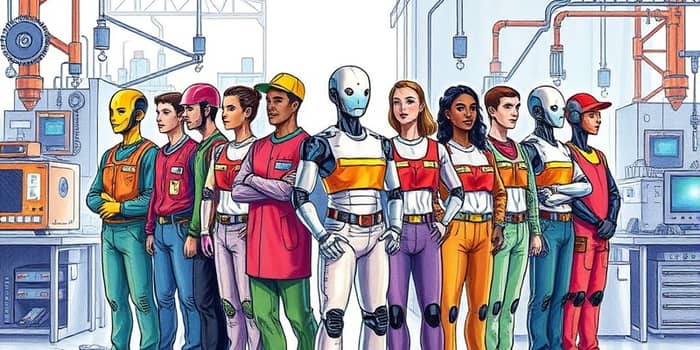
As we stand on the brink of a new industrial revolution powered by AI, robotics, and automation, society faces a profound paradox. Technological progress promises cheaper goods and higher productivity, yet it exacts a steep toll on human livelihoods and social fabric.
From factory floors to corporate offices, automated systems are reshaping work at an unprecedented scale. This article examines the scope of disruption, the communities most affected, and pathways toward a balanced future.
Unprecedented Scale of Disruption
The numbers are staggering. Between 2025 and 2030, robots and autonomous systems are projected to displace 5 million more jobs than they create globally. AI alone may replace 41% of existing roles, affecting 92 million positions by 2030.
In the United States, 47% of workers face automation risks over the next decade, with 1 in 10 already deemed replaceable. In the first half of 2025, nearly 78,000 tech roles vanished as companies chased efficiency.
Meanwhile, 30% of all hours worked in the US economy are set to be automated by 2030, up from earlier projections of 21%. As companies deploy 718,000 industrial robots in 2026 and invest in AI systems worth over $20 billion in 2025, the pace of change accelerates.
Who Suffers Most?
Automation does not impact everyone equally. Entry-level workers, low-skill roles, and routine data clerks bear the brunt of displacement.
- Young workers (16–24) face a 49% automation risk.
- Data entry and administrative staff: 7.5 million jobs gone by 2027.
- Retail employees: 65% of roles at risk by 2026.
Advanced economies are more exposed: 60% of jobs in OECD countries are vulnerable, compared to 40% globally. Workers without a bachelor’s degree confront a 55% automation potential, more than double that of degree-holders.
Sector-Specific Projections
These trends underscore the urgent need for proactive measures in education, workforce planning, and policy making.
Psychological and Societal Impact
Beyond economic figures, there is a human cost that numbers cannot fully capture. Serial layoffs erode morale, leading to anxiety, depression, and a loss of identity among displaced workers.
Communities dependent on factories and service centers experience cascading declines in local businesses, schools, and public services. As inequality widens, social cohesion frays, and political tensions rise.
Corporate Strategies: Replace or Reskill?
Employers face a strategic choice: automate roles outright or invest in reskilling and human-AI collaboration. In 2025, 77% of companies offered training for AI integration, yet 40% prioritized replacement over augmentation.
- 37–40% of US firms plan AI-driven cuts by end of 2026.
- 9 in 10 small businesses see AI as their competitive edge.
- 26% of large enterprises expect workforce reductions linked to AI.
When companies invest in people, they foster loyal teams with new capabilities. Yet, immediate cost pressures often bias decisions toward layoffs.
Skills for the Future Workforce
The evolving labor market demands new competencies. AI exposure reshapes job roles 66% faster than traditional skill shifts, accelerating the need for lifelong learning.
Key skills in demand include:
- Critical thinking and problem-solving.
- AI oversight, ethics, and prompt engineering.
- Complex communication and human-centric design.
Workers willing to adapt report greater resilience and job satisfaction. Yet, access to quality training remains uneven, reinforcing existing inequalities.
Policy Interventions and Social Safety Nets
Governments must explore social safety nets like universal basic income and targeted subsidies for reskilling programs. Policymakers can incentivize companies to maintain headcount by offering tax credits for training investments.
Collaborative approaches between industry, labor unions, and educational institutions can create apprenticeship pathways that match emerging technology needs.
Opportunities Amid Disruption
Despite challenges, automation also unlocks new frontiers. Roles in creative industries, human care, and AI ethics are expanding. Industry 5.0 envisions a symbiotic future where humans and machines co-create value.
Examples of emerging fields:
- AI health diagnostics and personalized medicine.
- Human-robot collaboration in manufacturing.
- Digital content curation and immersive experiences.
A Path Forward
Technology is neither friend nor foe; its impact depends on collective choices. By embracing ethical AI deployment, investing in people, and strengthening social safety nets, society can harness innovation for inclusive growth.
Each stakeholder—governments, businesses, educators, and individuals—must act with foresight and empathy. The true measure of progress lies not just in automation metrics, but in our ability to uplift every worker on the journey toward a shared future.
References
- https://fortunly.com/statistics/automation-job-loss-statistics/
- https://www.wearetenet.com/blog/ai-job-replacing-statistics
- https://zapier.com/blog/ai-statistics/
- https://www.hrdive.com/news/companies-will-replace-workers-with-ai-by-2026/760729/
- https://www.youtube.com/watch?v=20RCQC4vNf8
- https://www.nexford.edu/insights/how-will-ai-affect-jobs
- https://www.azilen.com/blog/ai-automation-future/
- https://hbr.org/2026/01/companies-are-laying-off-workers-because-of-ais-potential-not-its-performance
- https://www.automate.org/webinars/2026-industrial-automation-trends-what-to-expect-in-the-coming-year
- https://www.youtube.com/watch?v=nTWe3P7hjxs
- https://www.pwc.com/gx/en/services/ai/ai-jobs-barometer.html
- https://explodingtopics.com/blog/ai-replacing-jobs