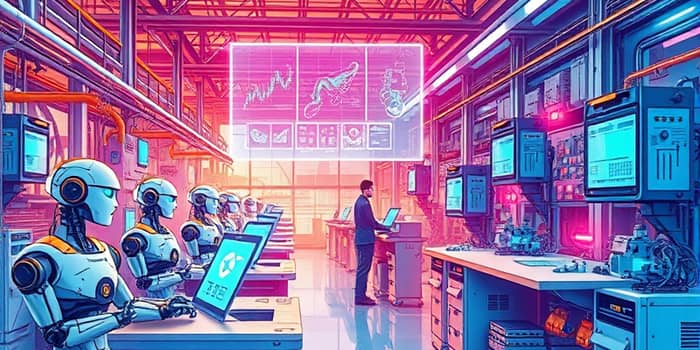
Imagine stepping into a factory where machines converse with each other, processes adapt instantly, and every decision is backed by data that flows like a river of insights. This is not science fiction—it’s the world of Industry 4.0, where our collective ingenuity meets advanced technology to reshape manufacturing’s future.
In this era of rapid change, businesses that harness the power of connectivity and intelligence will lead markets, drive sustainability, and delight customers. These innovations offer more than efficiency—they promise a new industrial renaissance defined by creativity, collaboration, and resilience in the face of global challenges.
Definition and Core Concepts
Industry 4.0, often dubbed the Fourth Industrial Revolution, transcends traditional factory automation by weaving together digital, physical, and biological systems. At its core, it integrates IoT, AI, robotics, analytics, and digital twins to form smart factories empowered by data.
Unlike past revolutions that centered on steam, electricity, or computing power alone, this transformation hinges on interconnected systems that self-optimize, enabling manufacturers to shift from mass production to true mass customization—tailoring products to individual needs without sacrificing efficiency.
Key Technologies Driving Change
Each technological pillar plays a vital role in redefining how products are designed, built, and delivered.
- Internet of Things (IoT/IIoT): Millions of sensors gather real-time data across machines, enabling predictive maintenance and energy optimization.
- Artificial Intelligence and Machine Learning: Intelligent algorithms analyze production trends, detect anomalies, and guide design innovations.
- Digital Twins: Virtual replicas of assets and processes simulate changes before they occur, minimizing risk and downtime.
- Automation and Robotics: Collaborative robots perform repetitive tasks alongside humans, boosting safety and throughput.
- Cloud Computing and Analytics: Powerful computing resources process vast datasets for instant insights and cross-site coordination.
- Additive Manufacturing: 3D printing unlocks complex geometries and rapid prototyping for unique, on-demand parts.
Together, these technologies form an integrated ecosystem of innovation capable of adapting to shifting demands and fueling continuous improvement.
Market Growth and Investment Trends
The global smart manufacturing market has grown from USD 130 billion in the early 2020s to well over USD 300 billion today. Forecasts predict it will exceed USD 1 trillion within the next decade, driven by relentless digitalization.
Enterprises are investing heavily—more than USD 2.5 trillion in 2024 alone—on upgrades that range from sensor deployments to full-scale platform migrations. Automation spending is projected to surpass USD 232 billion this year, reflecting the urgent push toward responsive, data-rich operations.
This table highlights regional dynamics and underscores where companies can focus investments to maximize returns and drive local innovation.
Regional Insights: Where Growth Thrives
In North America, cutting-edge AI logistics, robust infrastructure, and strong government incentives have propelled the region to the forefront of smart manufacturing adoption, delivering both cost reductions and enhanced supply chain resilience.
Across the Asia-Pacific region, rapid industrialization, rising labor costs, and substantial subsidies are accelerating the integration of IoT and robotics. Nations like China and India are leading with massive investments that promise mass customization for diverse markets.
Europe harmonizes sustainability goals with digital transformation, leveraging programs like the Horizon 2020 AI initiative and collaborative platforms such as Hannover Messe. Manufacturers here emphasize circular economy models and low-carbon operations.
In Latin America and the Middle East & Africa, emerging hubs are capitalizing on government-backed modernization funds and partnerships to develop agile, resilient plants that can pivot quickly in dynamic markets.
Benefits and Applications in Practice
At a fundamental level, Industry 4.0 delivers actionable insights that drive efficiency, quality, and flexibility.
- Predictive maintenance reduces unplanned downtime by up to 50%, saving millions in repair costs.
- Custom production lines enable lot-size-one manufacturing with minimal retooling and waste.
- End-to-end supply chain visibility cuts lead times and inventory costs, adapting to market fluctuations.
- AI-driven inspections elevate product quality and ensure consistency across batches.
Organizations that adopt these practices report rapid ROI, often within 12–18 months, as operational waste shrinks and throughput accelerates.
Practical Steps to Begin Your Industry 4.0 Journey
Embarking on a digital transformation can seem daunting, but a phased, purpose-driven approach lays the groundwork for sustainable success.
- Assess current maturity by mapping systems, devices, and data flows to identify gaps.
- Define clear, measurable objectives that align with business goals and customer expectations.
- Assemble a cross-functional team of IT, operations, and process experts to drive integration and change management.
- Launch pilot projects focused on high-impact areas—such as predictive maintenance or quality inspection—to demonstrate quick wins.
- Scale proven solutions across additional plants and supply chain nodes, fostering a culture of continuous improvement.
By following these guidelines, organizations can achieve sustainable, scalable transformation that empowers their workforce and strengthens competitiveness on the global stage.
Horizon of Innovation: Towards Industry 5.0
As we look beyond the current revolution, the next frontier—Industry 5.0—will focus on human-centric collaboration and personalized manufacturing. This phase will blend advanced automation with human creativity to unlock new levels of innovation.
Companies that prepare by investing in workforce upskilling, digital literacy programs, and human-machine interface design will position themselves at the vanguard of tomorrow’s industrial landscape.
Ultimately, embracing the human dimension—valuing creativity, empathy, and problem-solving—alongside cutting-edge technology will shape a more resilient, sustainable, and inclusive manufacturing ecosystem.
Conclusion: Seizing the Smart Manufacturing Era
The era of Industry 4.0 offers unprecedented opportunities for those bold enough to embrace its full potential. From improved productivity to novel business models, the benefits are within reach for any organization willing to act.
By taking decisive steps today—investing in sensors, analytics, and collaborative robotics—you can transform your operations into a dynamic, adaptive force ready for tomorrow’s challenges.
Choose to lead the charge in this industrial renaissance. Empower your teams, forge strategic partnerships, and cultivate a culture of innovation that will carry you into the next chapter of manufacturing excellence.
Step into the future and unlock a world of possibilities with transformative digital manufacturing strategies that redefine what’s possible.
References
- https://www.ibm.com/think/topics/industry-4-0
- https://www.imarcgroup.com/industry-4-0-market-statistics
- https://engineeringmastersonline.rutgers.edu/articles/industry-4-0-vs-5-0-whats-the-difference/
- https://www.gminsights.com/industry-analysis/industry-4-0-market
- https://www.jaggaer.com/blog/manufacturing-4-0-transforming-industry
- https://www.mordorintelligence.com/industry-reports/industry-4-0-market
- https://www.ptc.com/en/solutions/digital-manufacturing/industry-4-0
- https://www.fortunebusinessinsights.com/industry-4-0-market-102375
- https://www.microsoft.com/en-us/ai/manufacturing/resources/industry-4-0-technologies
- https://www.precedenceresearch.com/industry-4-0-market
- https://www.mckinsey.com/featured-insights/mckinsey-explainers/what-are-industry-4-0-the-fourth-industrial-revolution-and-4ir
- https://www.startus-insights.com/innovators-guide/industry-4-0-market-report-key-data/
- https://www.cisco.com/site/us/en/learn/topics/networking/what-is-industry-4-0.html
- https://teeptrak.com/en/industrie-4-0-2026-guide-smart-manufacturing/
- https://www.youtube.com/watch?v=DeyJM8lmi1E