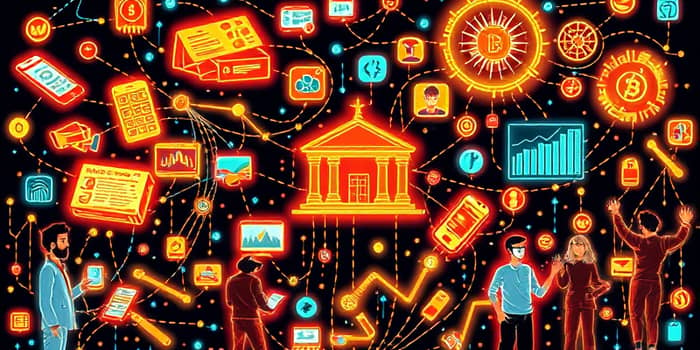
Over the past decade, the financial landscape has undergone a profound transformation. What began as small, agile startups challenging the status quo has blossomed into a full-scale movement reshaping how we save, spend, and invest. Today, the fintech revolution stands as a beacon of possibility, demonstrating unprecedented growth and opportunity for businesses, consumers, and communities around the world.
As we embrace this new era, it is clear that traditional finance is no longer confined to brick-and-mortar banks or paper records. Instead, modern solutions integrate seamlessly into our daily lives, offering speed, security, and convenience never seen before. From mobile wallets that transform daily financial habits to AI algorithms optimizing investment decisions in real time, fintech has become the engine driving inclusive and accessible services.
Rising Market Opportunities
The numbers tell a compelling story. The global fintech market was valued at $394.88 billion in 2025 and is projected to reach $460.76 billion in 2026, expanding at a CAGR of 18.20%. By 2034, experts expect the sector to surpass $1,760 billion, and long-term forecasts hint at crossing the $1 trillion threshold by 2032.
Regionally, North America leads with a 32.30% share in 2025, while Asia Pacific is poised to overtake the U.S. by 2032, driven by booming markets in China, India, and Japan. In the U.S. alone, fintech valuations are expected to climb from $60.4 billion in 2025 to $193.2 billion by 2034. These figures underscore how this industry has become an irresistible force, offering embedded payments and services across borders and platforms.
The Digital Payments Transformation
Digital payment methods have leapt forward, altering how we transact. The value stored in digital wallets soared tenfold from $1.6 trillion in 2014 to $15.7 trillion in 2024. Meanwhile, Buy Now, Pay Later services grew from $2.3 billion to $342 billion over the same period. These shifts represent real-time payment infrastructure taking center stage.
- Point-of-sale digital payments rose from 21% in 2014 to an anticipated 65% by 2030.
- Real-time transactions reached $60 trillion in 2025, and QR code payments now deploy at nearly 50% among merchants.
- Contactless, NFC, BNPL, and cryptocurrency services each see rapid adoption and exploration.
Generation Z Behavioral Shifts
Gen Z is driving change with relentless enthusiasm. Over 93% use peer-to-peer platforms and 91% favor mobile wallets. More than 40% of this cohort completes digital payments over five times per month, while cash use dwindles to a mere 7%. BNPL usage among Gen Z shot up from 26% to 46% in just one year.
These consumers demand seamless customer experiences, with 81% abandoning brands after poor payment interactions and 65% leaving after just two or three missteps. Their expectations are a clarion call for businesses to innovate or fall behind.
Key Trends Shaping 2026 and Beyond
Several forces will define the next chapter of fintech disruption:
- Real-time payments moving from pilot to standard across payroll, treasury, and supply chains.
- AI-powered innovations projected to reach $41.16 billion by 2030, enabling hyper-personalized user experiences.
- Embedded finance platforms integrating lending, insurance, and payments into non-financial apps.
- Decentralized finance (DeFi) set to exceed $300 billion in total value locked by 2026, blending tokenized assets and traditional markets.
Industry Disruption and Resilience
Banks are reinventing themselves, embedding services invisibly into daily life. By 2026, retail banking will claim 36.90% of the market thanks to swift onboarding, digital wallets, and contactless payments.
At the same time, neobanks face survival challenges as infrastructure-first fintechs capture greater value. Fraud and trust management emerge as critical competitive edges, with fraud detection and deepfake resistance shaping customer confidence.
Building the Future: Infrastructure and Inclusion
A robust ecosystem underpins fintech’s ascent. Over 94 regulatory sandboxes worldwide foster experimentation, while 31,801 fintech companies collaborate, compete, and merge. Traditional banks are integrating with fintech tools, creating a hybrid landscape of agility and scale.
Personalization and inclusive finance are at the heart of innovation. AI-driven robo-advisors and budgeting apps extend professional planning to underserved communities, delivering inclusive financial platforms that empower individuals across socioeconomic lines.
Empowering Consumers and Businesses
Success in this evolving environment requires a strategic approach. Organizations and consumers alike can take practical steps to thrive:
- Partner with fintech innovators to accelerate digital payment adoption.
- Leverage AI for data-driven insights and customer engagement.
- Implement embedded finance tools to deepen loyalty and increase revenue streams.
- Prioritize cybersecurity and fraud prevention to maintain trust.
Conclusion
The fintech revolution is more than technology—it’s a human story of empowerment, inclusion, and ingenuity. As we navigate this dynamic landscape, the opportunity to shape the future of finance lies in our hands. By embracing innovation with agility and focusing on customer-centric solutions, businesses can lead with confidence, and consumers can enjoy frictionless and instant payments that enrich everyday life.
Now is the time to be part of this transformative journey, harnessing the power of fintech to build a more inclusive, efficient, and vibrant financial world.
References
- https://softjourn.com/insights/fintech-stats
- https://www.fortunebusinessinsights.com/fintech-market-108641
- https://thefinanser.com/2026/01/115369
- https://www.imarcgroup.com/united-states-fintech-market
- https://execed.business.columbia.edu/disrupting-the-finance-world-how-fintech-is-changing-the-game-for-businesses
- https://www.mordorintelligence.com/industry-reports/us-fintech-market
- https://www.moderntreasury.com/journal/2026-fintech-predictions-key-trends-in-payments-banking-and-financial-infrastructure
- https://stablecoininsider.org/50-fintech-statistics-in-2026/
- https://www.trinetix.com/insights/fintech-trends
- https://www.precedenceresearch.com/fintech-as-a-service-market
- https://www.bdo.com/insights/industries/fintech/2026-fintech-industry-predictions
- https://www.omnicalculator.com/reports/fintech-statistics
- https://www.taylorwessing.com/en/insights-and-events/insights/2026/01/fintech-outlook-2026
- https://www.quantumrun.com/consulting/fintech-market-trends/
- https://www.researchnester.com/reports/business-analytics-in-fintech-market/8069