In today’s globalized world, money moves not in isolation but as part of a vast, living network. Understanding this network helps individuals, businesses, and policymakers navigate opportunities and risks with confidence.
Understanding the Financial Ecosystem
The term financial ecosystem describes an interconnected network of institutions that facilitate the circulation of capital. It is more than a static chart of banks and exchanges; it is a dynamic web where actors continuously interact.
At its core, this ecosystem comprises diverse components—institutions, markets, instruments, and participants—working in concert to support economic activity and growth.
- Financial Institutions
- Financial Markets
- Financial Instruments
- Regulatory Framework
- Market Participants
Drivers of Evolution and Change
Several forces shape how the ecosystem adapts over time. Technological innovation, regulatory shifts, and human incentives all play a role in fluidity and adaptive evolution.
Key foundational drivers include:
- Infrastructure and payment systems
- Governance and compliance frameworks
- Human decision-making dynamics
- Cross-border geopolitical factors
Global Flows and Key Trends
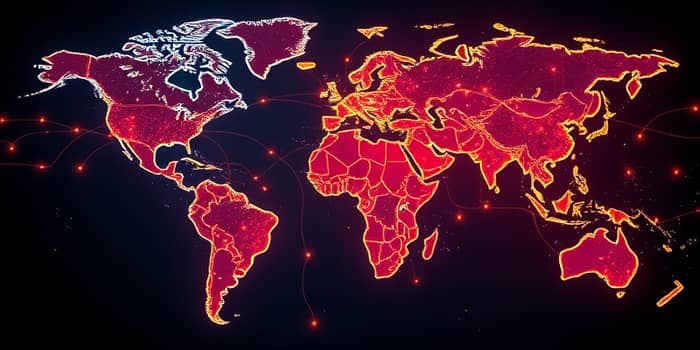
Between 2011 and 2021, global financial flows to ODA-eligible countries reached unprecedented levels, totaling US$3 trillion in 2021 alone. These flows illustrate how commercial flows dominate the landscape of international capital.
Key trends reveal a sharp COVID-19 dip in 2020, followed by recovery driven by FDI, remittances, and a tripling of short-term debt. Yet over 40% of these countries face moderate to high debt stress.
Role of Major Actors
Banks, insurers, investment firms, and market infrastructures each contribute unique functions. Together, they form a network where roles can shift and expand under pressure.
- Banks: daily payment systems and credit intermediation
- Investment Firms: capital allocation and wealth management
- Insurance Companies: risk mitigation and synthetic credit provision
- Market Infrastructure: exchanges and price discovery mechanisms
Resilience and Fluidity in Crisis
During market stress, actors often migrate across roles. A universal bank may originate loans, securitize assets, provide payment rails, and inject liquidity simultaneously—all reflecting the ecosystem’s inherent resilience.
The pandemic highlighted both vulnerabilities and adaptability. Travel restrictions collapsed tourism flows, while digital remittances surged, underscoring how quickly money corridors can shift.
Shaping the Future: Collaboration and Innovation
The next frontier lies in deep collaboration across traditional silos. Cutting-edge technology and evolving governance models will underpin a cutting-edge technology-enabled service providers landscape where value is shared.
- Adopt open APIs and digital platforms to expand reach
- Diversify funding sources to mitigate debt stress
- Invest in risk analytics to anticipate market shifts
- Forge partnerships that leverage complementary strengths
- Promote sustainable finance and inclusive growth
By embracing a multi-lateral dynamic environment enabling innovation and prioritizing mutuality and shared value creation, stakeholders can harness the full potential of the interconnected money flows. The path forward demands foresight, collaboration, and a commitment to resilience.
As money continues to flow and networks evolve, understanding the financial ecosystem empowers leaders and communities to build a more inclusive and sustainable future.
References
- https://askfilo.com/user-question-answers-smart-solutions/define-the-term-financial-ecosystem-and-explain-its-main-3435353237323631
- https://devinit.github.io/resources/international-finance-flows-2000-to-2021/
- https://ccgit.crown.edu/cyber-reels/decoding-the-financial-ecosystem-a-comprehensive-guide-1767648388
- https://www.bis.org/publ/qtrpdf/r_qt1703b.htm
- https://jemi.edu.pl/call-for-papers-archive/603-financial-ecosystems-concepts-and-practice
- https://fred.stlouisfed.org/categories/32251
- https://anandautar.substack.com/p/the-financial-ecosystem-a-foundational
- https://www.newyorkfed.org/research/blog/2019_LSE_Markets_Interactive_afonso
- https://www.zuehlke.com/en/insights/financial-services-ecosystem-guide
- https://www.federalreserve.gov/econres/rsfof-staff.htm
- https://www.nefe.org/initiatives/ecosystem/default.aspx
- https://impact.stanford.edu/article/mapping-money-data
- https://www.fdic.gov/analysis/bank-data-statistics
- https://www.ici.org/research/stats/mmf