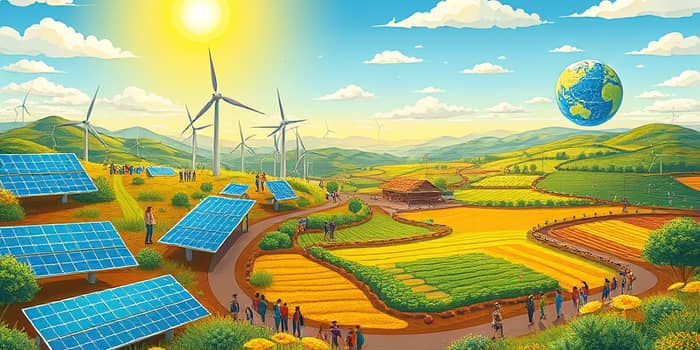
The shift from fossil fuels to clean energy is no longer a distant aspiration—it’s a defining chapter in our global story. As nations and communities embark on this journey, they unlock unprecedented economic potential while confronting formidable challenges. Understanding these opportunities and obstacles is essential for crafting effective strategies and fostering an inclusive, prosperous future for all.
Understanding the Energy Transition
The energy transition represents the systematic replacement of coal, oil, and natural gas with renewable sources such as solar, wind, geothermal, and biomass. This evolution aims at achieving net-zero carbon emissions by mid-century, in line with commitments made at COP21 and COP26. Success hinges on coordinated policy frameworks, large-scale infrastructure deployment, and rapid technological innovation.
Government incentives, private capital flows, and community engagement form the backbone of this transformation. Transitional fuels like natural gas may serve as bridges, but the long-term focus remains on efficiency, grid modernization, and direct renewables investment.
Economic Opportunities
The transition to clean energy is not only an environmental imperative—it’s a catalyst for transformative job creation and economic renewal. As old industries wane, new sectors spring to life, driving growth across regions.
- Clean energy employment surge: Global jobs in renewables grew from 30 million in 2019 to 35 million in 2023, with projections adding 10 million more by 2030.
- Wholesale price reductions: Renewables could lower U.S. electricity prices by 20–80% by 2040, boosting household budgets and corporate profitability.
- Record-breaking investment trends: Clean energy funding reached $2 trillion in 2024—$800 billion more than fossil fuels—with a 70% decade-over-decade increase.
Rural communities and manufacturing hubs stand to gain disproportionately from cheaper power. In the United States, solar and wind projects on public lands have generated over 12,000 construction jobs and nearly 1,700 operations roles since 1996, while contributing millions in royalties to federal and state coffers.
Regional and Sectoral Benefits
Benefits extend beyond headline figures. Regions with abundant sun or wind resources can achieve policy-driven investment shifts that revitalize local economies. For example, solar productivity in Arizona is over twice that in Maine, and wind output in South Dakota eclipses Florida by more than fivefold.
Manufacturers enjoy reliable, low-cost electricity, spurring expansion. Data centers, logistics firms, and agri-businesses all capitalize on predictable power prices, reducing overhead and driving wages upward by 2–3% in competitive regions.
Overcoming Key Obstacles
Despite the promise, the path forward is strewn with challenges. Infrastructure, policy alignment, supply chains, and geopolitical factors all demand proactive solutions.
Firstly, large-scale transmission networks are required to connect remote renewable sites to load centers. Balancing solar peaks and wind lulls across state lines necessitates billions in grid upgrades and regional planning cooperation.
Secondly, policy and investment gaps risk undermining progress. A mere five-year delay in decarbonization could push global warming toward 3.1°C, dramatically increasing climate risks. Ensuring stable, long-term incentives for clean energy deployment is critical.
Thirdly, the scramble for critical minerals—lithium for batteries, rare earths for magnets—raises supply-chain vulnerabilities. Diversifying sources, recycling materials, and supporting domestic processing capabilities are essential mitigation strategies.
Finally, geopolitical shifts may affect energy markets and investment flows. Export controls, trade tensions, and inconsistent regulatory standards can hinder global coordination and elevate costs.
A Call to Action for Stakeholders
Achieving a successful energy transition requires collective global ambition and coordinated action at every level. Stakeholders must align efforts to scale solutions rapidly and equitably.
- Governments: Implement robust carbon pricing, streamline permitting processes, and fund research into storage, hydrogen, and carbon capture.
- Investors: Redirect capital from fossil fuels into renewables, grid modernization, and sustainable infrastructure financing.
- Businesses: Adopt renewable energy procurement, improve energy efficiency in operations, and foster workforce retraining programs.
- Communities: Advocate for local clean-energy projects, support workforce development initiatives, and participate in decision-making processes.
Education and public engagement are equally vital. Empowering citizens with knowledge about energy choices fuels grassroots support and accelerates policy adoption.
Looking Ahead: Scenarios and Projections
The future trajectory of global warming and energy systems rests on the decisions we make today. Several scenarios illustrate potential outcomes:
These pathways underscore the urgency of scaling renewables, expanding grid capacity, and deploying emerging technologies like CCUS and green hydrogen. Every fraction of a degree matters—progress now shapes the health of ecosystems, economies, and communities for generations.
Conclusion
The energy transition embodies both a monumental challenge and a transformational opportunity. By harnessing strategic long-term growth and innovation, societies can create millions of jobs, drive down energy costs, and protect the planet from irreversible climate impacts.
Success demands unwavering commitment from governments, private sector leaders, and citizens alike. It calls for bold policies, sustained investments, and a shared vision for a cleaner, more equitable world.
As we stand at this crossroads, the choices we make will reverberate for centuries. Embracing the energy transition today is not just an economic imperative—it’s our collective legacy.
References
- https://www.nationalgrid.com/stories/energy-explained/what-clean-energy-transition
- https://www.brookings.edu/articles/the-economic-impacts-of-clean-power/
- https://energytracker.asia/what-is-energy-transition-an-ultimate-guide/
- https://cbey.yale.edu/research/key-economic-benefits-of-renewable-energy-on-public-lands
- https://www.nwo.nl/en/overview-pages/energy-transition
- https://www.wri.org/insights/state-clean-energy-charted
- https://www.energy-transitions.org/home-materials-report/
- https://www.deloitte.com/us/en/insights/industry/renewable-energy/renewable-energy-industry-outlook.html
- https://www.woodmac.com/market-insights/topics/energy-transition-outlook/
- https://www.un.org/en/climatechange/raising-ambition/renewable-energy
- https://earth.org/energy-transition-where-are-we-headed-in-2026/
- https://www.pvfarm.io/blog/how-investing-in-renewable-energy-drives-growth-and-prosperity
- https://www.spglobal.com/energy/en/news-research/special-reports/energy-transition/horizons-top-cleantech-trends-2026
- https://ourworldindata.org/renewable-energy
- https://about.bnef.com/insights/finance/energy-transition-investment-trends/