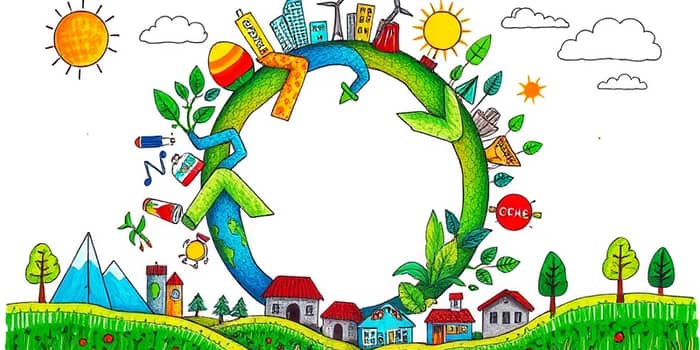
In a world overwhelmed by overconsumption and pollution, waste as a valuable resource emerges as a paradigm shift. By reimagining discarded materials as inputs for new processes, the circular economy strives to eliminate the linear 'take-make-waste' model and foster regeneration across industries and ecosystems.
Redefining Waste in the New Economy
The traditional view treats waste as an inevitable byproduct destined for landfills or incinerators. In contrast, the circular model treats every end‐of‐life product as a stock of recoverable materials. This designs out waste and pollution from the outset, ensuring that products and materials remain in continuous use through repair, refurbishment, remanufacturing, and recycling.
By prioritizing minimizing virgin resource extraction, businesses reduce dependency on finite reserves and mitigate climate impact. Municipalities, corporations, and individuals alike can adopt practices that transform the waste hierarchy—reduce, reuse, recycle—into a holistic blueprint for sustainability.
Core Principles Guiding the Blueprint
The circular economy’s success rests on a few foundational pillars:
- Design for Circularity: Engineering products for easy disassembly and recovery of components.
- Zero Waste Targets: Integrating waste reduction strategies from concept through end-of-life.
- Regeneration Focus: Restoring natural systems by cutting resource extraction and fostering biodiversity.
These principles demand collaboration among designers, manufacturers, governments, and consumers. By embedding circularity into policy, supply chains, and consumer behavior, societies can systematically close material loops and drive resilient economies.
Waste-to-Resource Technologies in Action
Technological innovation is the engine powering large-scale circularity. Breakthrough processes convert organics, plastics, electronics, and more into energy, fuels, and raw materials.
Innovations like thermal decomposition of organics or digital passports for supply chains are extending the scope of circular solutions. From insect bioconversion to hydrothermal processing of wet biomass, each method unlocks new resource streams that were once considered worthless.
Real-World Case Studies
Across the globe, pioneering projects demonstrate the blueprint in action. In Vilnius, Lithuania, a co-generation plant converts municipal waste into heat and power with near-100% efficiency, creating jobs and slashing landfill use. In Belgium, a gasifier operating 24/7 prevents over 2,400 tons of CO₂ emissions annually. Meanwhile, Fulcrum BioEnergy’s Sierra facility produces aviation syncrude from household garbage, showing that even highly technical sectors can embrace circularity.
On a smaller scale, startups are transforming consumer habits. Ecozap upcycles tire rubber and plastic bottle caps into stylish footwear. Sheedo’s seed-embedded paper returns organic fibers to the soil when planted. These ventures prove that closing material loops for good is both financially viable and socially inspiring.
Environmental, Economic, and Social Gains
The benefits of shifting to a circular model span multiple dimensions:
- Environmental Impact: Up to 90% reduction in greenhouse gas emissions, major decreases in pollution, and substantial carbon sequestration via biochar.
- Economic Opportunities: Lower raw material costs, new revenue streams from byproducts, and job creation in recycling, remanufacturing, and waste-to-energy sectors.
- Social Resilience: Enhanced energy security, reduced supply chain vulnerabilities, and stronger community engagement through local recycling and repair initiatives.
By viewing waste as an asset, companies can differentiate their brands, comply with tightening regulations, and win consumer loyalty in markets increasingly concerned with sustainability.
Overcoming Barriers to Circularity
Transitioning from theory to practice is not without challenges. Key obstacles include:
- Insufficient data transparency in waste streams and product lifecycles.
- High upfront investment for advanced waste-processing facilities.
- Regulatory frameworks still optimized for linear systems.
Addressing these hurdles requires public–private partnerships, aligned incentives, and robust metrics to track progress. Consumer education and industry collaboration are essential to foster demand for recycled materials and redesigned products.
Practical Steps for Organizations and Individuals
Every stakeholder can contribute to the circular revolution:
- Audit material flows to identify waste hotspots and recycling opportunities.
- Incorporate design-for-disassembly into product development cycles.
- Invest in or partner with waste-to-resource technology providers.
- Support policies that incentivize reuse, remanufacturing, and renewable energy from waste.
- Adopt lifestyle changes: repair items, choose products with recycled content, and practice mindful consumption.
By taking these actionable steps, communities and companies can build momentum toward a zero-waste future.
Conclusion: Embracing a Regenerative Future
The circular economy’s blueprint reimagines the end-of-life as a new beginning. By treating waste not as a problem but as resource potential waiting to be unlocked, we can regenerate natural systems, drive economic growth, and enhance social well-being.
Success demands bold ambition, cooperation across sectors, and a willingness to innovate. As we scale up waste-to-resource technologies and embed circular principles into every decision, we move closer to an era of true sustainability—one where prosperity and planetary health flourish together.
References
- https://lifestyle.sustainability-directory.com/learn/how-does-the-concept-of-waste-as-a-resource-fit-into-the-circular-economy/
- https://climatetechdigital.com/top-10/top-10-waste-to-resource-technologies
- https://www.rts.com/resources/guides/circular-economy/
- https://www.group.sener/en/insights/from-waste-to-resource-6-examples-of-circular-economy/
- https://www.epa.gov/circulareconomy/what-circular-economy
- https://www.gihub.org/infrastructure-technology-use-cases/case-studies/converting-waste-to-renewable-energy/
- https://www.europarl.europa.eu/topics/en/article/20151201STO05603/circular-economy-definition-importance-and-benefits
- https://www.wastetodaymagazine.com/article/waste-to-energy-and-conversion-technology-thoughts-on-where-we-are-today/
- https://www.unepfi.org/pollution-and-circular-economy/circular-economy/
- https://extension.psu.edu/resource-recovery-turning-waste-into-energy/
- https://greenly.earth/en-us/blog/company-guide/circular-economy-definition-and-principles
- https://www.youtube.com/watch?v=WwDOat0Cljc
- https://www.ellenmacarthurfoundation.org/topics/circular-economy-introduction/overview
- https://lee-enterprises.com/key-methods-of-waste-to-energy-conversion/
- https://professionalprograms.mit.edu/blog/sustainability/circular-economy/