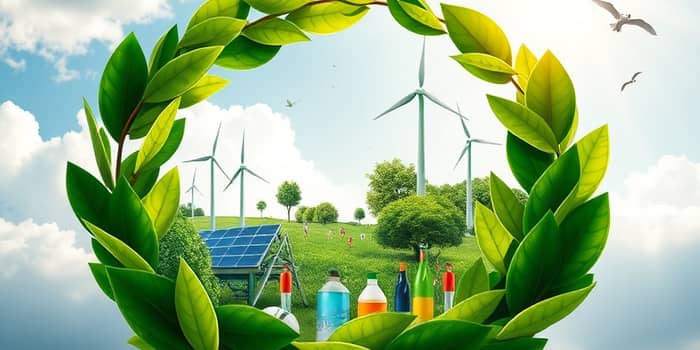
In a world where resources are dwindling and ecosystems are strained, a profound shift is underway. The circular economy offers a blueprint for renewed prosperity by embracing regeneration over depletion.
Redefining Growth in the 21st Century
Traditional economic systems follow a linear path: extract, produce, use, and discard. This model has fueled unprecedented development, but at a steep environmental cost. Landfills overflow, greenhouse gas emissions soar, and biodiversity collapses under the weight of waste.
By contrast, the circular economy is restorative and regenerative by design. It challenges the notion that growth must equal consumption of finite resources. Instead, it decouples expansion from resource depletion, ensuring lasting value at every turn.
Core Principles of Circular Design
At its heart lie three pillars that transform how we create, use, and regenerate:
- Design out waste and pollution: Products use durable, high-quality materials optimized for disassembly and renewal, eliminating the very concept of waste.
- Keep products and materials in use: Strategies such as sharing, leasing, repairing, refurbishing, and recycling maximize value over multiple lifecycles.
- Regenerate natural systems for biodiversity: Restoring ecosystems, rebuilding soil health, and switching to renewable energy replenish the planet’s resources.
Environmental Benefits of Circularity
Moving from a linear to a circular approach yields immediate gains for the planet. By keeping materials in play and nurturing ecosystems, we can:
- Up to 70% reduction in material use, lowering pressure on virgin resources and landfill expansion.
- Potential to halve CO2 emissions by 2030 compared to 2018 levels, closing 85% of the emissions gap.
- 60-85% smaller product environmental footprint through improved design and lifecycle management.
- Enhanced biodiversity and soil health by avoiding habitat disruption.
Economic Advantages and Business Innovation
Beyond ecological wins, circular models unlock powerful financial benefits. Companies and communities find resilience and growth by rethinking traditional value chains:
- Businesses can save up to 25% on materials by integrating recycled inputs, cutting costs and reducing waste disposal.
- Revenue growth may increase seven-fold through service-based models, resale platforms, and product-as-a-service offerings.
- Global savings of $640 billion by 2050 from improved material efficiency and reduced landfill expenses.
- Greater resilience to supply chain volatility and geopolitical risk, bolstering long-term competitiveness.
Real-World Success Stories
Innovators around the globe are proving that circular practices are not just theoretical—they deliver real impact and inspire hope:
This snapshot demonstrates how diverse sectors—from fashion to healthcare—are embracing circularity to foster innovation and create new revenue streams.
Overcoming Barriers and Catalyzing Change
Despite its promise, the transition to a circular economy faces challenges. Established industries often resist fundamental redesigns, and upfront investments in research, development, and infrastructure can be daunting.
Policy support is essential. Governments must incentivize sustainable design through extended producer responsibility, tax benefits for recycled materials, and robust renewable energy frameworks. Collaboration across public, private, and civil sectors accelerates knowledge sharing and risk mitigation.
Consumers also play a pivotal role. By choosing products designed for longevity, participating in repair and sharing networks, and supporting brands committed to transparency, individuals drive market demand for circular solutions.
A Call to Action for a Regenerative Future
The circular economy is more than a set of strategies—it’s a shift in mindset. It asks us to see waste as opportunity, to value longevity over disposability, and to steward resources for generations to come.
As entrepreneurs, policymakers, consumers, and innovators, we each hold a piece of the solution. Embrace industrial systems that are restorative and regenerative, champion bold business models, and advocate for policies that embed circularity at every level.
Together, we can build a future where economic prosperity and environmental stewardship walk hand in hand. The moment to act is now—our planet and our collective well-being depend on it.
References
- https://youmatter.world/en/definition/definitions-circular-economy-meaning-definition-benefits-barriers/
- https://www.interlakemecalux.com/blog/circular-economy
- https://www.boardofinnovation.com/blog/circular-business-model-examples/
- https://www.okonrecycling.com/consumer-recycling-initiatives/learn-about-recycling/what-is-circular-economy/
- https://www.group.sener/en/insights/from-waste-to-resource-6-examples-of-circular-economy/
- https://www.europarl.europa.eu/topics/en/article/20151201STO05603/circular-economy-definition-importance-and-benefits
- https://www.weforum.org/stories/2022/01/5-circular-economy-business-models-competitive-advantage/
- https://greenly.earth/en-us/blog/company-guide/circular-economy-definition-and-principles
- https://www.ellenmacarthurfoundation.org/topics/circular-economy-introduction/examples
- https://www.ellenmacarthurfoundation.org/topics/circular-economy-introduction/overview
- https://sustainabilitymag.com/top10/top-10-brands-embracing-the-circular-economy-in-2023
- https://www.milliken.com/en-us/blogs/circular-economy-sustainability
- https://www.shiftcities.org/circular-economy-strategies-sustainable-development
- https://climatepromise.undp.org/news-and-stories/what-is-circular-economy-and-how-it-helps-fight-climate-change