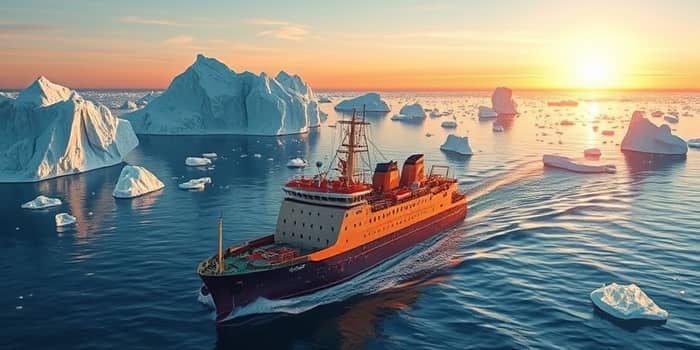
In recent decades, the Arctic region has shifted from a frozen frontier to a dynamic arena for global transportation and commerce. Rapidly melting ice and longer navigable seasons have unveiled unprecedented opportunities for shipping companies, energy producers, and national economies. As the world grapples with climate change, the emergence of these high-latitude pathways demands not only careful navigation but also thoughtful policies and sustainable practices. Stakeholders must balance the promise of shorter routes and cost savings with the imperative to protect fragile ecosystems and honor the rights of indigenous communities.
Emergence of New Arctic Shipping Lanes
Climate-driven transformations are opening sea lanes that were once impassable for commercial vessels. The four primary routes—Northern Sea Route, Northeast Passage, Northwest Passage, and Transpolar Sea Route—each present unique advantages and challenges. Collectively, they offer potential reductions in transit time of up to 40 percent compared to traditional corridors such as the Suez or Panama Canals. Yet, navigating these waters requires specialized ice-class vessels, precise meteorological forecasting, and robust logistical support. Understanding each corridor’s distinctive characteristics is essential for operators seeking to capitalize on this evolving maritime landscape.
- Northern Sea Route (NSR) – Skirting Russia’s Arctic coastline through the Barents, Kara, Laptev, East Siberian, and Chukchi Seas, providing access to Murmansk and Asian markets.
- Northeast Passage (NEP) – Encompassing the NSR and adjacent Barents Sea sections, often used interchangeably, with strategic significance for Europe–Asia trade.
- Northwest Passage (NWP) – Winding through Canada’s Arctic Archipelago, first fully navigable in 2007, linking the Atlantic and Pacific Oceans.
- Transpolar Sea Route (TSR) – Crossing the central Arctic Ocean, projected to become seasonally accessible by mid-century, promising the most direct path.
To traverse these corridors, vessels must meet rigorous ice-class standards, typically 1A or higher, and contend with variable depths and narrow straits. The Yugorskiy Shar and Laptev Strait restrictions, for instance, impose draft and beam limitations that restrict the largest container ships. Despite these obstacles, pioneering voyages have demonstrated the viability of Arctic logistics, setting the stage for broader commercial exploitation over coming years.
Economic Opportunities and Transformations
In economic terms, the advent of Arctic shipping lanes represents a paradigm shift for global trade networks. The most immediate benefit lies in 30-40% shorter transit routes that translate into significant fuel savings, faster delivery of goods, and the potential for additional voyage cycles per season. For mining operations in Greenland and Canada, marine transport offers a lifeline to international markets, reducing reliance on expensive overland infrastructure. Similarly, energy projects in Russia’s Yamal Peninsula and Alaska’s North Slope stand to gain from year-round ice-class LNG vessels that can bypass congested chokepoints like the Suez Canal.
Beyond shipping, the ripple effects extend to port development, shipbuilding, and allied services. Emerging hub ports in Kirkenes (Norway), Vopnafjörður (Iceland), and Murmansk are investing in deep-water berths, storage facilities, and icebreaking fleets. These infrastructures not only facilitate cargo handling but also spur regional employment, offering new careers in logistics, engineering, and environmental monitoring. Local communities are witnessing an influx of capital and skill-building programs, though they are also navigating the complex demands of integrating traditional lifestyles with modern industrial activities.
As maritime traffic intensifies, insurance providers and financial institutions are tailoring products for high-latitude voyages, reflecting both the higher risks and the lucrative rewards. Collaborative ventures between government agencies and private operators are funding research into next-generation navigation technologies, including satellite-based ice mapping and autonomous vessels. Such innovations promise to further enhance time and cost efficiencies, solidifying the Arctic’s role as a transformative corridor for global commerce.
Environmental and Social Challenges
While the economic prospects are enticing, the environmental stakes are equally high. The Arctic ecosystem is one of the most sensitive on Earth, with slow recovery rates and species that are uniquely adapted to cold environments. Increased ship traffic raises the risk of oil spills, black carbon deposition that accelerates ice melt, and the introduction of invasive species. Moreover, noise pollution can disrupt marine mammals such as bowhead whales and narwhals, threatening their breeding patterns and migratory routes.
Indigenous communities who have depended on hunting, fishing, and herding for generations face new pressures from industrial encroachment. Balancing cultural heritage and economic integration requires robust consultation frameworks and benefit-sharing agreements. Without thorough environmental impact assessments, projects risk marginalizing local voices and eroding traditional knowledge systems. Collaborative governance models that include indigenous representation at every decision-making level are critical to ensuring that development does not come at the expense of community well-being.
Geopolitical Dynamics
As strategic interest in the Arctic intensifies, nations are asserting sovereignty claims and expanding military presence. Russia has amplified its icebreaker fleet and established polar bases, while Canada patrols the Northwest Passage through the Royal Canadian Navy and Coast Guard. These moves underscore the broader security dimension of Arctic navigation, where controlling shipping lanes also means safeguarding national interests. Simultaneously, non-Arctic states, including China and the European Union, are investing in research missions and bilateral partnerships, seeking a stake in future resource extraction and transit rights.
Geopolitical risks can exacerbate competition over marine corridors, leading to overlapping claims and diplomatic friction. Navigational freedoms under the United Nations Convention on the Law of the Sea provide some legal clarity, but comprehensive multilateral agreements are still evolving. Stakeholders must reconcile national security imperatives with commercial aspirations, forging cooperative frameworks that promote safe navigation, environmental stewardship, and equitable access.
Charting a Sustainable Future
Looking ahead, the promise of Arctic shipping lanes hinges on finding the right balance between economic development and environmental and social responsibility. International bodies such as the International Maritime Organization and the Arctic Council are crafting regulations to govern icebreaker operations, pollution controls, and indigenous consultation processes. Technological innovations, including advanced hull designs, real-time ice monitoring, and hybrid propulsion systems, will further mitigate operational risks and emissions.
Companies and governments must adopt adaptive management strategies that account for shifting sea ice patterns and evolving community needs. By investing in training programs for indigenous youth, supporting community-led research, and incorporating traditional ecological knowledge, projects can achieve both profitability and preservation. Ultimately, the story of the Arctic route will be written not only by captains and CEOs but by the collective choices of policymakers, scientists, and the people who call the polar regions home.
References
- https://www.thearcticinstitute.org/future-arctic-shipping/
- http://toolkit.climate.gov/arctic-development-and-transport
- https://en.wikipedia.org/wiki/Arctic_shipping_routes
- https://www.belfercenter.org/publication/arctic-shipping-trends-challenges-and-ways-forward
- https://polarres.eu/impacts/shipping/
- https://www.arcticiceproject.org/what-will-happen-if-new-shipping-routes-open-up-in-the-arctic/
- https://arcticportal.org/shipping-portlet/shipping-routes
- https://environment-review.yale.edu/navigating-north-seas-balancing-environmental-and-cultural-concerns-arctic-shipping
- https://www.lmitac.com/news/trends-in-arctic-shipping-a-decade-of-transformation
- https://arctic-council.org/news/increase-in-arctic-shipping/