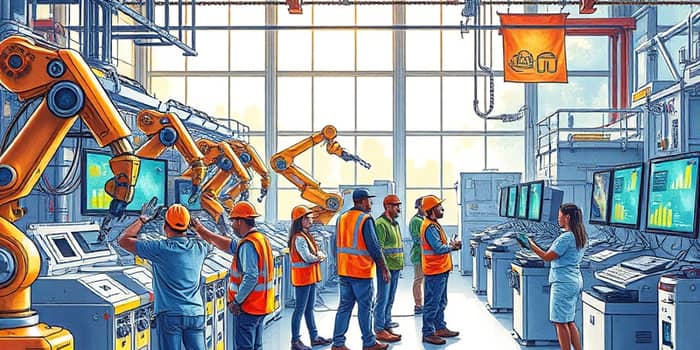
In an era defined by supply chain disruptions and geopolitical uncertainty, the United States is witnessing a powerful renaissance in domestic manufacturing. This resurgence, often termed economic nationalization of strategic industries, seeks to restore production capabilities and strengthen regional supply networks. As businesses and policymakers align incentives, reshoring has emerged as a transformative force reshaping the nation’s industrial landscape.
Across sectors from semiconductors to concrete, stakeholders are embracing regionalization over traditional offshoring to mitigate risks and foster resilience. The following exploration provides an in-depth look at the drivers, challenges, and opportunities fueling this historic shift.
Understanding Reshoring and Its Scope
Reshoring refers to the relocation of manufacturing activities back to domestic soil, reversing decades of offshoring trends. It often goes hand in hand with nearshoring—moving production to neighboring countries—and friendshoring, which favors allied nations.
Collectively, these regionalized strategies aim to create more predictable, localized sourcing strategies, reducing vulnerabilities tied to long-distance logistics and single-country dependencies. In the United States, approximately 74% of manufacturers are actively pursuing either reshoring or nearshoring initiatives.
Key Statistical Drivers
Data underscores the momentum behind domestic revitalization. Over 56.9% of U.S. manufacturers anticipate rising output in the coming months, forecasting a 2.5% boost in production and a 2.6% increase in sales on average.
- Semiconductor projects alone will create over 500,000 new American jobs.
- Private sector commitments exceed US$500 billion to expand chipmaking capacity by 2032.
- Spending on digital transformation is set to reach $1 trillion by 2031.
Meanwhile, automation investment surged 20.8% last year, signaling that manufacturers are embedding advanced technologies to drive efficiency and agility.
Sector Growth at a Glance
Primary Economic and Policy Incentives
Government policies have been pivotal. The One Big Beautiful Bill Act (OB3) expanded tax credits for advanced manufacturing from 25% to 35%, while a 15% tariff on all imports incentivizes domestic production. A combination of a weaker dollar, lower corporate tax rates, and regulatory streamlining further tilts the scales.
These measures are complemented by new trade agreements with the United Kingdom and Vietnam, aiming to stabilize input costs and provide policy certainty. Manufacturers report that reliable regulations—even at slightly higher costs—foster confidence for long-term capital investment.
Technology Integration and Digital Transformation
The reshoring wave is inseparable from Industry 4.0. Facilities are evolving into interconnected ecosystems of sensors, robotics, and cloud-based analytics. Autonomous systems that self-optimize are rapidly replacing legacy operations, enabling plants to sense variability and adjust processes without human intervention.
Digital twins and generative AI are laying the groundwork for future breakthroughs. By simulating production lines and predicting equipment failures, manufacturers can minimize downtime and improve throughput. This fusion of physical and digital realms positions U.S. facilities at the forefront of global competitiveness.
Building a Skilled Domestic Workforce
As jobs return, workforce development has become a strategic imperative. The transition to automated processes demands new skill sets in programming, data analysis, and systems management.
- Companies partner with technical schools and universities to create targeted reskilling and upskilling programs.
- Operators shift from manual tasks to exception management and system oversight.
- Engineering teams devote more time to refining AI algorithms and validating data quality.
These efforts cultivate a talent pipeline equipped to thrive in digitally enabled manufacturing environments.
Sustainability and Environmental Innovation
Green manufacturing is another pillar of reshoring. Over 2,800 companies worldwide employ sustainable practices, with thousands prioritizing clean power and circular approaches. U.S. firms are recovering materials, extending product lifecycles, and integrating renewable energy to reduce carbon footprints.
Decentralized manufacturing, leveraging AI, IoT, and industrial 3D printing, allows for small-batch, localized production. This model not only minimizes waste but also fosters community-based resilience by distributing capacity across multiple sites.
Future Outlook for Manufacturers
Looking toward 2026 and beyond, U.S. manufacturers face multiple scenarios: continued steady growth, potential contraction, or a robust rebound driven by interest rate cuts. Early adopters of reshoring and digital innovation are already outpacing competitors, reporting higher profitability and stronger market positions.
- Regional supply networks will become the standard for critical industries.
- Friendshoring alliances will secure access to strategic materials.
- Sustained investment in automation will accelerate output and quality gains.
Companies that weave together policy incentives, workforce development, technological prowess, and sustainability will shape the next era of American manufacturing.
The economic nationalization of industries through reshoring represents more than a tactical response to disruptions; it marks a visionary commitment to sovereignty, innovation, and community prosperity. By aligning public policy with private ambition, the United States is poised to reclaim its status as a global industrial leader.
References
- https://www.ibisworld.com/blog/2026-us-roundtable/1/1126/
- https://www.forvismazars.us/forsights/2026/02/manufacturing-modernization-four-trends-to-watch-in-2026
- https://www.deloitte.com/us/en/insights/industry/manufacturing-industrial-products/manufacturing-industry-outlook.html
- https://nam.org/top-manufacturing-trend-for-2026-autonomous-smart-operations-35545/
- https://www.global-imi.com/blog/what-will-drive-manufacturing-2026
- https://evocon.com/articles/5-key-manufacturing-trends-that-will-shape-2026/
- https://blogs.opentext.com/3-manufacturing-trends-for-2026-that-nobodys-talking-about/
- https://www.stibosystems.com/blog/manufacturing-trends-and-insights
- https://www.epicflow.com/blog/top-manufacturing-trends-whats-new/