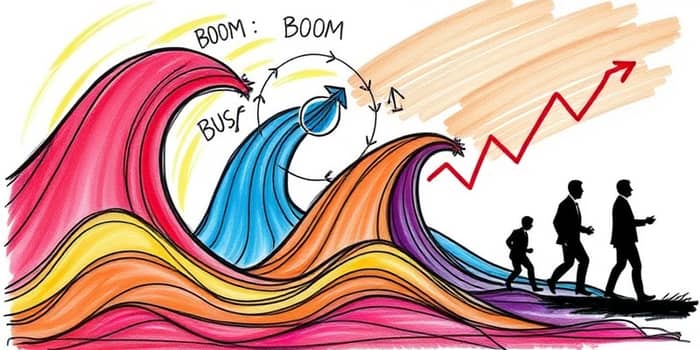
Markets and economies flow through repeating patterns of growth and decline. Learning to read these cycles can transform uncertainty into opportunity.
Defining Market and Business Cycles
Market cycles track trends in asset prices and investor behavior over time. Unlike economic cycles, which focus on GDP, employment, and inflation data, market cycles reflect the collective sentiment driving stocks, bonds, and commodities. While linked, these cycles do not align perfectly: markets often rally before an economic recovery arrives and decline ahead of a recession.
Stocks often lead real economic data because investors price in expectations about corporate profits, policy shifts, and consumer demand. Recognizing this early edge is essential for capitalizing on emerging trends.
Conversely, business cycles measure the broad economy. They encompass periods of expansion, peaks, contractions, and troughs. Policymakers and central bankers closely monitor these phases to adjust interest rates, taxation, and stimulus measures.
Phases of Market Cycles
Every market cycle unfolds in four stages. Despite no fixed duration and clear boundaries, these phases share common characteristics that can guide investment decisions.
To sharpen timing, traders often employ the Wyckoff method. This approach analyzes volume and price divergences to detect accumulation or distribution by large operators. Spotting a selling climax or automatic rally can signal early entry or exit points.
Advanced indicators such as moving averages and sentiment surveys complement these tools. Layering multiple signals reduces false alarms and improves the odds of identifying a genuine phase shift.
Phases of Economic Cycles
While market cycles center on asset prices, economic cycles track real output and job creation. Here are the four standard phases:
- High sustained growth during expansion phases: Output, employment, and wages rise steadily.
- Growth plateaus at cyclical peaks: Economic activity slows, inflation risks heighten.
- Sharp contraction in downturn periods: GDP falls, credit markets tighten, unemployment climbs.
- Stimulus supports recovery and resurgence: Policy measures and renewed confidence drive a rebound.
Business cycle lengths vary, but expansions typically last longer than recessions. Average recessions last nine to eleven months, whereas expansions can stretch several years, punctuated by mid-cycle slowdowns.
Root Causes of Booms and Busts
Market and economic swings arise from interacting factors. Recognizing these drivers improves preparedness and informs protective strategies.
- Rapid changes in short-term interest rates: Extended low rates fuel borrowing; sudden rate hikes can trigger sharp corrections.
- Collective shifts in investor sentiment: Fear and greed cycle between extremes, amplifying price moves.
- Credit expansions followed by intense contractions: Easy lending inflates bubbles; credit freezes deepen downturns.
- Technological leaps and regulatory shifts: Innovations or new laws can create fresh booms or accelerate busts.
External shocks, from geopolitical events to pandemics, interact with these fundamental drivers, shaping the severity and duration of each cycle.
Historical Patterns and Sector Insights
Examining past booms and busts reveals that different industries respond uniquely to cycle phases. Consumer staples and utilities often outperform during contractions due to their consistent demand. Meanwhile, cyclical sectors like energy, industrials, and discretionary retail shine in expansions but can suffer steep declines when growth fades.
During the 2008 financial crisis, defensive stocks outperformed as credit markets froze. In contrast, the dot-com bubble saw technology equities soar and crash dramatically when overvaluation peaked. By contrasting sector performance across multiple cycles, investors can tailor allocations to current and expected phases.
Monitoring leading indicators—such as building permits, new orders, and consumer confidence—offers a window into sector rotation patterns. Early signals of shifting momentum can guide overweight or underweight decisions before broader market trends unfold.
Investment Strategies and Policy Implications
Cycle awareness enables proactive portfolio adjustments. Key strategies include:
- Buying quality, undervalued assets during early accumulation phase value opportunities to build exposure ahead of markups.
- Gradually trimming positions as valuations become stretched in markup stage, while maintaining momentum exposure.
- Increasing cash or bond holdings to embrace defensive asset allocations at market peaks and preserve capital.
- Shifting to defensive sectors and high-grade bonds during markdowns to limit losses and safeguard purchasing power.
At the policy level, central banks use cycle analysis to set interest rates and employ quantitative measures. Their goal is to smooth out extremes—cooling overheated economies or stimulating activity in downturns—without triggering unwanted inflation or debt crises.
Practical Takeaways and Outlook
Recognizing cycle phases is less about precise timing and more about adjusting probabilities in your favor. By combining fundamental research, technical analysis, and sentiment metrics, you can better anticipate turning points.
Successful navigation relies on maintaining flexibility. A rigid, one-size-fits-all approach can lead to missed opportunities or unmanaged risk. Instead, align asset allocation with prevailing cycle conditions and emerging indicators.
Keep in mind that no two cycles unfold identically. Geopolitical tensions, demographic shifts, and technological disruptions continually reshape the cycle landscape. Continuous learning and adaptation are vital.
Ultimately, mastering market and economic cycles empowers you to transform volatility into a strategic ally. With disciplined research and a forward-looking mindset, you can harness the power of booms and busts to pursue long-term financial goals.
References
- https://corporatefinanceinstitute.com/resources/economics/market-cycle/
- https://www.analyticssteps.com/blogs/boom-and-bust-cycles-causes-phases-and-ways-protect
- https://aspiriant.com/fathom/market-cycle-and-business-cycle-laymans-guide/
- https://www.britannica.com/money/stages-of-economic-cycle
- https://www.leelynsmith.com/insights/article/business-and-market-cycles-what-investors-should-know-qa-with-our-cio-brian-dorn/
- https://www.youtube.com/watch?v=FkLJuJ0hRLs
- https://www.fingerlakeswm.com/post/market-cycles
- https://phys.org/news/2026-02-economy-booms.html
- https://www.etoro.com/en-us/investing/market-and-economic-cycles/
- https://codinginterviewsmadesimple.substack.com/p/the-boom-bust-cycle-and-how-it-affects
- https://en.wikipedia.org/wiki/Stock_market_cycle
- https://fordschool.umich.edu/news/2019/stevenson-summarizes-boom-bust-cycle-likelihood-next-recession
- https://www.oanda.com/us-en/trade-tap-blog/trading-knowledge/market-cycles-key-indicators-guide/
- https://www.everycrsreport.com/reports/RL34072.epub
- https://www.schwab.com/learn/story/four-stages-stock-market-cycles