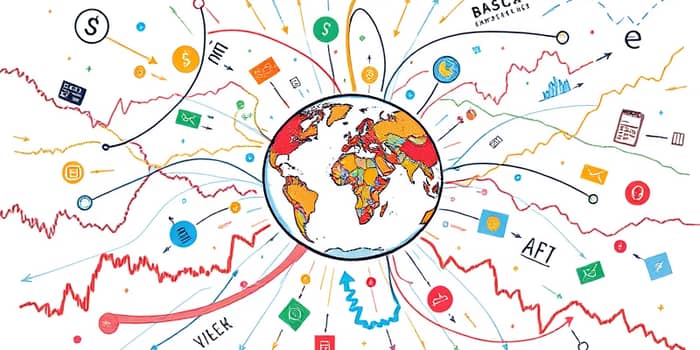
In a world of ever-evolving economic ties, mastering how currencies move alongside equities can unlock unparalleled insights. This guide dives deep into the forces at play and offers practical strategies to navigate forex and stocks in harmony.
Introduction to Forex Markets
The foreign exchange (forex) market is renowned as the largest financial market in the world, with participants ranging from global banks to retail traders.
Every day, over $6 trillion in trades pass hands as organizations convert one currency into another, seeking to profit from minute price variations.
At its core, forex involves the conversion of one currency to another to capitalize on exchange rate fluctuations across markets, driven by a tapestry of fundamental and sentiment factors.
Core Forex Fundamentals
The value of a currency hinges on a complex mix of drivers that reflect economic health, policy decisions, and trader mood. Below is a concise breakdown of the most influential factors:
Traders blend top-down macro analysis—evaluating GDP, policy moves, and global events—with bottom-up research focusing on individual pair characteristics.
Stock Market-Currency Correlations
Equity indices and forex pairs share a two-way relationship fueled by global capital flows. Strong stock performance attracts overseas investors who must buy the local currency, boosting its value.
Conversely, turbulent equity markets can trigger risk aversion, sending funds into traditional safe havens like the US dollar or Swiss franc.
- Positive Correlation: Bullish equities often lead to a stronger domestic currency.
- Negative Correlation: Market sell-offs drive demand for safe-haven currencies.
- Time-Lag Effects: One market can signal moves in another days ahead.
Specific Correlations and Historical Examples
Certain pairs and indices exhibit consistent patterns that savvy traders monitor closely:
- USD/JPY vs. DJIA & Nikkei 225: The yen often tracks major US and Japanese stock averages.
- EUR/USD & GBP/USD: These pairs display strong positive synchrony due to interconnected economies.
- USD/CHF & EUR/USD: Historically, these pairs reveal strong negative correlation in periods of market stress.
During the 2008 crisis, USD/CHF soared as both the US dollar and Swiss franc became refuges, while EUR/USD plunged sharply on eurozone concerns.
Practical Impacts and Trading Strategies
Recognizing these interdependencies empowers traders to craft more resilient portfolios. For example, a sustained rally in the S&P 500 often signals growing risk appetite, which can weaken safe-haven currencies.
Two analytical frameworks guide decision-making:
- Top-Down Analysis: Begin with central bank announcements, geopolitical shifts, and major economic releases before selecting currency pairs.
- Bottom-Up Analysis: Focus on the characteristics of individual currency pairs or sectors, then broaden out to global trends.
Risk management approaches such as pairing negatively correlated instruments—like EUR/USD and USD/CHF—can smooth volatility and protect against sudden market reversals.
Key Data Points and Quantitative Metrics
Solid trading strategies rely on clear numerical benchmarks:
Standard lot sizes range from micro (1,000 units) to mini (10,000 units) and standard (100,000 units), allowing precise position scaling.
With over $6 trillion daily turnover, forex markets offer deep liquidity, ensuring tight spreads and swift trade execution.
Correlation coefficients span from +1 (perfect sync) to -1 (perfect inverse). Typical cross-market metrics include:
EUR/USD vs. USD/CHF at -0.85; USD/JPY vs. DJIA around +0.70; AUD/USD vs. gold near +0.65—illustrating how commodities, equities, and currencies interlink.
Conclusion
Forex and stock markets are woven together through fundamental economics, investor psychology, and global capital movements. By mastering interest rates, trade balances, and key data releases—and by observing equity trends—traders can anticipate currency shifts rather than react to them.
Integrating these insights with disciplined risk controls and diversified positions fosters more confident and strategic trading decisions that adapt to an ever-changing financial landscape.
References
- https://www.ig.com/en/forex/what-is-forex-and-how-does-it-work
- https://www.tradingview.com/chart/EURUSD/DpzYdukD-STOCK-MARKET-AND-FOREX-CORRELATION/
- https://www.oanda.com/us-en/learn/fundamental-analysis/introduction-to-fundamental-analysis/
- https://www.dukascopy.com/swiss/english/marketwatch/articles/forex-correlation-pairs/
- https://www.babypips.com/learn/forex/fundamental-analysis
- https://www.fpmarkets.com/education/platform-guides/understanding-the-relationship-of-the-stock-market-with-the-forex-market/
- https://www.youtube.com/watch?v=frzjivWWYGE
- https://www.myfxbook.com/forex-market/correlation
- https://www.schwab.com/learn/story/foreign-exchange-forex-trading-beginners
- https://www.cmcmarkets.com/en-sg/forex/currency-correlations
- https://www.guggenheiminvestments.com/advisor-resources/interactive-tools/asset-class-correlation-map