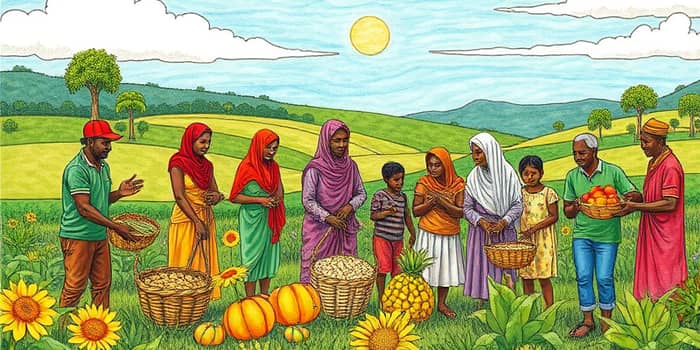
In an era where crises converge, ensuring access to nutritious food has become both a moral duty and an economic necessity for societies worldwide. The World Food Programme warns that 318 million people face acute hunger in 2026, marking a 20% increase since 2020. This surge demands urgent action from governments, businesses, and communities to safeguard stability and prosperity.
Scaling Crisis: Global and U.S. Realities
The magnitude of global food insecurity is staggering. Recent estimates reveal that nearly 300 million individuals now experience acute food shortages, a figure that has nearly tripled since 2016. Conflict zones such as Sudan, the Gaza Strip, and parts of the Sahel region account for millions of the world’s most severe hunger cases, with 41 million people at Emergency levels (IPC Phase 4 or worse).
Economic shocks and displacement have further exacerbated the crisis. Rising fuel and fertilizer costs have squeezed farmers’ margins and driven up food prices even as global grain supplies remain ample. Meanwhile, donor support has dwindled, with humanitarian funding falling back to 2016 levels, leaving vulnerable populations at greater risk.
In the United States, the problem takes on different contours. The USDA reports that 13.5% of households—some 18 million people—are food insecure, up from 12.8% in 2022. Of these, 8.4% experience low food security and 5.1% very low security, often forcing parents to skip meals to feed their children. Households with children are disproportionately affected, with 17.9% reporting food insecurity.
The economic dimension in the U.S. cannot be overstated. Food insecurity is both a cause and consequence of poverty. Access to the Supplemental Nutrition Assistance Program lifts an estimated 3.6 million people out of poverty, and every dollar spent on SNAP yields roughly two dollars in economic activity. Yet, 58 million globally stand to lose aid due to funding gaps, and in the U.S., benefit reductions or program barriers risk reversing decades of progress.
Economic and Environmental Drivers
Food insecurity stems from a web of economic pressures and environmental stressors that undermine the right to adequate nutrition. Understanding these drivers helps target solutions where they are most needed.
- Widespread poverty and unemployment limit household purchasing power for healthy foods.
- Major conflicts and displacement disrupt agricultural production and supply chains.
- Climate extremes and land degradation reduce crop yields and degrade pastures.
- Market volatility and price spikes erode affordability despite supply.
- Policy gaps and trade barriers hinder cross-border food flows and investment.
Land degradation from unsustainable agriculture has driven 90% of global deforestation in search of new farmland. Droughts, floods, and unpredictable weather patterns now pose constant threats rather than episodic events, further stressing fragile food systems.
Hidden hunger, marked by micronutrient deficiencies, also persists. An estimated two billion people worldwide suffer from inadequate vitamin and mineral intake, impairing cognitive development and weakening immune systems.
Health, Economic, and Social Impacts
The toll of food insecurity is multidimensional, affecting physical health, mental well-being, and social cohesion. Malnutrition kills more people each year than AIDS, tuberculosis, and malaria combined.
- Child stunting and wasting are prevalent in 53 countries, threatening the next generation’s potential.
- Chronic disease risks increase with reliance on calorie-dense, nutrient-poor foods.
- Mental health challenges such as anxiety and depression rise in food-deprived households.
- Social instability escalates where communities compete for scarce resources.
Economically, undernourished populations struggle to maintain productivity, driving up healthcare costs and draining national budgets. Social fabric frays as inequalities deepen, fueling migration and conflict over finite resources.
Women and children bear a disproportionate burden. In many countries, up to one-third of female-headed households face food shortages, while youth unemployment traps younger generations in cycles of deprivation.
Innovative Responses and the Path Forward
Faced with this crisis, international institutions, governments, and civil society are mobilizing resources and expertise. The World Bank has committed to supporting 90 countries, aiming to benefit 327 million people by 2030 through targeted resilience programs.
Programs exemplify how climate-smart agriculture and market access foster sustainable improvements. For example, Honduras’s COMRURAL initiatives have created over 6,000 jobs in agriculture, emphasizing gender and youth inclusion. East and Southern Africa projects channel $2.75 billion into crisis response and resilient value chains, while West African efforts invest $766 million in digital services to anticipate future shocks.
At the global policy level, a joint statement by the FAO, IMF, World Bank, WFP, and WTO calls for urgent action to rescue hunger hotspots, streamline trade, and incentivize private sector involvement. This aligns immediate humanitarian aid with long-term strategies to build equitable, durable supply chains vs. short-term efficiency.
National governments play a crucial role. In the U.S., strengthening SNAP, simplifying enrollment, and expanding eligibility can shield millions from falling through the cracks. Investing in community food hubs, school feeding programs, and local cooperatives ensures that economic gains translate into improved nutrition.
Private sector engagement is equally critical. Corporations can mobilize investment in innovative technologies, from drought-resistant seeds to mobile platforms that connect farmers with markets. Impact investors have an opportunity to deploy capital where it can both earn returns and drive social good.
- Increase humanitarian funding to match escalating needs.
- Reform subsidies and trade policies to enhance market efficiency.
- Prioritize climate adaptation and sustainable land use.
- Foster public-private partnerships for innovation.
The FAO’s $2.5 billion appeal for 2026 highlights the financing gap. Closing this gap requires coordinated resource mobilization from multilateral agencies, donor countries, and private philanthropy.
Long-term resilience demands systemic change. This includes promoting agroecological practices, protecting biodiversity, and investing in rural infrastructure. When farmers have access to roads, storage, and financial services, they can withstand shocks and contribute to local and national economies.
Community-driven models amplify impact by ensuring that solutions are tailored to context. Participatory programs that engage local leaders, farmers’ cooperatives, and women’s groups drive sustainable adoption of best practices.
As we look ahead, it is clear that food security must be framed not only as a humanitarian issue but as a cornerstone of economic development. By linking nutrition, health, and productivity, stakeholders can create virtuous cycles of growth that lift people out of poverty and foster stability.
We stand at a moment of choice: to let funding shortfalls and policy inertia deepen a crisis, or to catalyze change through bold, collaborative action. The path forward demands vision, financing, and unwavering commitment to the principle that no individual should face hunger in a world of abundance.
Now is the time for decisive, collaborative action to safeguard our collective future and affirm that food security is not just an aspiration but a measurable indicator of global economic success.
References
- https://www.worldbank.org/en/topic/agriculture/brief/food-security-update
- https://frac.org/hunger-poverty-america
- https://www.fao.org/emergencies/appeals/global-appeal/en
- https://pmc.ncbi.nlm.nih.gov/articles/PMC9362113/
- https://www.rescue.org/article/5-urgent-problems-world-faces-2026
- http://www.ers.usda.gov/topics/food-nutrition-assistance/food-security-in-the-us/key-statistics-graphics
- https://www.wfp.org/publications/wfp-global-outlook
- https://www.thinkglobalhealth.org/article/feeding-dignity-a-2026-blueprint-for-food-aid-in-a-divided-world
- https://www.wfp.org/publications/global-report-food-crises-grfc
- https://concernusa.org/news/world-hunger-facts/
- http://www.ers.usda.gov/topics/food-nutrition-assistance/food-security-in-the-us
- https://odphp.health.gov/healthypeople/priority-areas/social-determinants-health/literature-summaries/food-insecurity
- https://www.usda.gov/about-food/food-safety/food-security