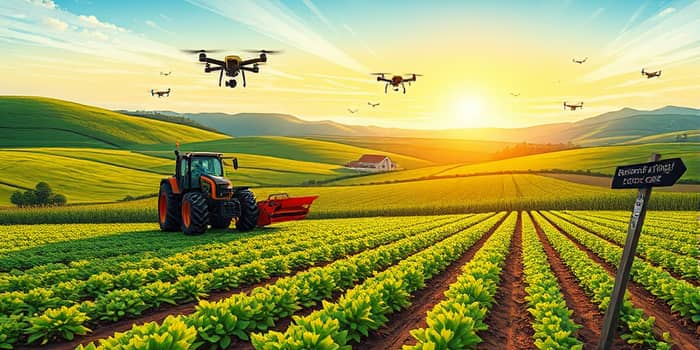
Sustainable agriculture stands at the crossroads of environmental stewardship and robust financial returns. In an era of mounting global challenges—climate change, water scarcity, soil degradation—investors and innovators are redirecting capital towards solutions that yield both profit and planetary health. This article explores the 2026 landscape for sustainable agri-investment, offering insights and practical guidance for stakeholders eager to generate meaningful impact.
In 2024, global AgTech investments reached $16 billion, with valuations projected to hit $74 billion by 2034 at a 12.2% compound annual growth rate. Despite predictions of decline, U.S. farmland values rose 4.3% to a record $4,350 per acre in August 2025, signaling enduring confidence in land-based assets. Investors are balancing risk and reward by focusing on scalable innovations and resilient supply chains.
As we enter 2026, venture capital, private equity and institutional funds are accelerating commitments to climate-adaptive crops, AI-driven precision systems and regenerative frameworks that promise unprecedented growth and opportunity. From Silicon Valley to regional agricultural belts, the convergence of technology and ecology is reshaping how we produce, distribute and consume food.
The Rising Tide of AgTech Investments
Funding is pouring into five dominant segments: plant science, precision agriculture, livestock technology, carbon and regenerative solutions, and enabling tech such as AI, data analytics and automation. Breakthroughs in genomics and microbiome engineering enable crops to thrive under extreme conditions, while remote sensing and edge computing refine farm management in real time.
Nonetheless, 36% of small farms still plan to adopt AI solutions, challenged by data bias and lack of digital infrastructure. To bridge this gap, strategic partnerships between technology providers, philanthropies and local cooperatives are essential. Impact investors can structure blended financing facilities to underwrite equipment leasing and training, fostering inclusive growth.
Core Innovations Driving Impact
Regenerative agriculture and de-chemicalization lead the charge in restoring ecosystems. By eliminating or reducing synthetic fertilizers and pesticides, farmers enhance biodiversity and water quality. Techniques such as no-till planting, cover cropping and pyrolysis-generated biochar improve soil structure and lock away carbon for decades.
- Engineered soil microbiomes that enhance drought resilience
- Nanobubble-infused irrigation systems for water efficiency
- Biochar applications to sequester stable carbon
- Blockchain-enabled traceability for supply chain transparency
Biologicals and field robotics are moving from pilot to mainstream. Edible sensors embedded in produce measure ripeness and nutrient content, while autonomous machinery carries out targeted spraying and weeding, minimizing chemical use. Livestock tech—from precision feeding platforms to wearable health monitors—improves animal welfare and reduces emissions, supporting regenerative agriculture market growth.
Unlocking Financial and Environmental Value
Carbon farming is transforming fields into income-generating assets. Verified farms in Europe earn between €40 and €90 per hectare for documented CO2 removal, attracting corporate buyers seeking to offset footprints. Scaling these programs requires robust measurement protocols and digital registries.
Innovative business models are emerging:
- Direct-to-consumer online marketplaces offering farm-to-table transparency
- Retailer–farmer–bank consortiums rewarding sustainability certifications
- Traceability platforms reducing food waste by up to 20%
These approaches not only deliver returns but also strengthen community relations and brand reputation. Investors should look for ventures that integrate social impact metrics alongside financial performance, ensuring alignment with Environmental, Social and Governance (ESG) criteria.
Navigating Regulatory and Market Challenges
Global policy shifts are creating both headwinds and tailwinds. The EU’s Common Agricultural Policy is redirecting subsidies toward eco-schemes and digital advisory services, while the EU–Mercosur trade pact exposes European producers to low-cost competition. In the U.S., USDA’s AI strategy (FY25–26) lays out ethical data use guidelines, accelerating adoption while safeguarding smallholders.
Macro factors such as geopolitical tensions and raw material price swings demand agility. Investors should diversify portfolios across regions and subsectors, using scenario analysis to stress-test assumptions and ensure long-term resilience.
Practical Steps for Investors and Innovators
To capitalize on this transformative moment, stakeholders must embrace an integrated approach combining capital, expertise and collaboration. Key actions include:
- Conduct thorough due diligence on agronomic and climate data
- Co-create financing structures with local stakeholders
- Fund training and support services for technology adoption
- Integrate robust measurement frameworks for carbon and biodiversity
- Engage policy makers to de-risk innovative ventures
By following these steps, you can build profitable portfolios that also advance global food security and environmental restoration. Whether you’re a venture capitalist exploring seed-stage opportunities or an established agribusiness pivoting to sustainability, the roadmap to impact and return is clear.
The challenge of feeding 9.7 billion people by 2050 with minimal environmental strain may seem daunting, but history shows human ingenuity thrives under pressure. With cutting-edge AI-biotech hybrids, advanced robotics and regenerative practices, we are positioned to transform agriculture from a source of degradation to a beacon of renewal. The time to invest is now; the future of food depends on bold action today.
Join the Food Futures movement—align your investment strategy with enduring ecological stewardship and social prosperity. Together, we can cultivate a resilient food system that nourishes people, protects the planet and delivers sustainable returns for generations to come.
References
- https://www.harvestreturns.com/blog/2025/12/9/2026-agriculture-investment-outlook
- https://manufacturing-journal.net/press-release/4593-ten-key-trends-set-to-shape-the-agricultural-sector-in-2026
- https://animalagtech.com/articles/2026-ag-investment-outlook
- https://www.itonics-innovation.com/food-and-drink-trends
- https://www.agtechnavigator.com/Article/2026/01/29/ten-trends-that-will-shape-farming-in-2026/
- https://www.startus-insights.com/innovators-guide/agriculture-trends/
- https://www.visionaryvogues.com/agri-tech-revolution-2026-smart-farming-food-security
- https://www.schroders.com/en-us/us/institutional/insights/2026-sustainable-investment-outlook-7-key-trends-for-north-america-in-the-year-ahead/
- https://atami.com/blog/cultivation/plant-based-trends-to-watch-smarter-greener-growing-for-2026
- https://www.icl-group.com/blog/future-of-agtech-2026/
- https://www.dadascope.com/blog/2026/1/20/8-trends-shaping-how-well-eat-in-2026
- https://www.lombardodier.com/insights/2026/january/5-must-watch-sustainable-investing.html
- https://www.ilsoy.org/top-trends-for-agriculture-in-2026/
- https://www.americancentury.com/institutional-investors/investment-outlook/sustainable-investing-trends/