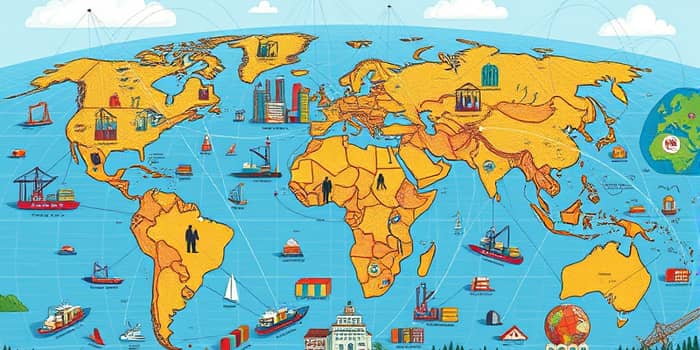
Over the last three decades, the world embraced unprecedented economic interdependence and trade. Yet recent shocks—from a global pandemic to geopolitical tensions—have revealed the vulnerabilities in our finely tuned networks. Today, businesses and governments are reexamining the assumptions of boundless globalization, seeking greater resilience in national production, and forging new models that blend connectivity with security.
From Hyperglobalization to Slowbalization
In the late twentieth century, the rise of digital technology, liberalized trade barriers, and multinational supply chains drove an era of hyperglobalization. Companies chased lowest-cost inputs across continents, while consumers enjoyed a flood of affordable goods.
However, by the 2010s, growth in cross-border trade began to falter. The term “slowbalization” surfaced to describe trade expanding at just 2.3 percent annually—lagging behind global GDP growth of 2.5 percent. This shift signaled that the era of ever-accelerating integration was yielding to a more measured pace, and soon after, deglobalization accelerated that trend further.
Key Drivers of Deglobalization
A convergence of factors has driven nations and firms to retrench. These include health crises, political fracturing, and environmental imperatives that challenge the sustainability of sprawling supply networks.
- Geopolitical conflicts and sanctions—such as those following Russia’s invasion of Ukraine—have prompted nations to limit dependencies and diversify partnerships.
- Global health emergencies and semiconductor shortages exposed critical supply weaknesses, spurring widespread reshoring efforts.
- Climate policies and border tariffs like the EU’s Carbon Border Adjustment Mechanism incentivize localized, low-carbon production models.
- Economic and policy uncertainty across major markets fosters a scramble for more secure, proximate sourcing strategies.
Economic Impacts and Emerging Trends
As global trade growth slows to 2.3 percent annually, nations face a future where regional blocs reshape economic interactions. By 2026, overall growth is projected at around 2.6 percent, with developing economies outside China potentially expanding at 4.2 percent.
Investment patterns are also shifting. Capital once funneled into established markets now targets emerging economies with robust domestic demand, including South Korea, India, and Vietnam. Meanwhile, digitally deliverable services continue their ascent, though significant gaps remain in less developed regions.
Opportunities Amid Fragmentation
While some view deglobalization as a looming crisis, it also presents openings for strategic growth. Nations and businesses can harness regional strengths, build local capacities, and foster innovation tailored to specific markets.
- Connector economies such as Mexico, Poland, and Vietnam can leverage their location, skilled labor, and investor attention to attract manufacturing and logistics hubs.
- South-South collaboration is expanding rapidly, with developing nations trading more among themselves to the tune of $6.8 trillion by 2025.
- Dual-track production models balance sensitive local manufacturing with broader regional networks, blending cost efficiency and security.
Strategies for Resilience and Inclusive Growth
Stakeholders across the public and private sectors must adapt with foresight. Resilience is not merely about shortening supply chains but creating adaptive, responsive ecosystems.
- Invest in diversified sourcing across multiple regions to reduce single-point failures and increase agility.
- Strengthen local capabilities through workforce upskilling and support for small and medium enterprises to drive domestic innovation.
- Adopt sustainable practices with green technology implementation and circular economy solutions to meet environmental and security objectives.
Looking Ahead: Balancing Security and Connectivity
The path forward will require nuanced policy choices and collaborative frameworks. Fully reversing globalization is neither practical nor desirable, but unbridled integration without guardrails proved fragile.
Reglobalization, the concept of optimizing networks for both resilience and cost, may represent a middle ground. By localizing critical production—such as semiconductors or medical supplies—while maintaining open trade in less sensitive sectors, nations can achieve a balanced approach.
Ultimately, the global community faces a defining moment. We must decide whether to embrace fragmented regional blocs or foster renewed multilateralism. The decisions made today will shape our collective ability to tackle shared challenges—from climate change to technological governance.
As deglobalization reshapes the world economy, individuals, businesses, and governments alike can seize this moment to build systems that are not only efficient but also equitable and sustainable. By blending the best elements of interconnection with robust safeguards, we can chart a course toward a more secure and inclusive future.
References
- https://moderndiplomacy.eu/2024/09/20/the-current-trend-of-de-globalization-protectionism-and-resource-nationalism/
- https://iagam.ca/insights/the-changing-landscape-of-global-trade
- https://www.ai-cio.com/news/deglobalization-a-theme-that-could-define-2026/
- https://www.weforum.org/stories/2026/01/reglobalization-world-economy-growth/
- https://unctad.org/publication/global-trade-update-january-2026-top-trends-redefining-global-trade-2026
- https://www.spglobal.com/en/research-insights/market-insights/geopolitical-risk/evolution-of-deglobalization
- https://www.eurasiareview.com/10022026-de-globalization-reshapes-the-logic-of-global-growth-analysis/
- https://ceritypartners.com/insights/2026-economic-and-market-outlook/
- https://www.icis.com/explore/resources/imagining-a-deglobalized-world/