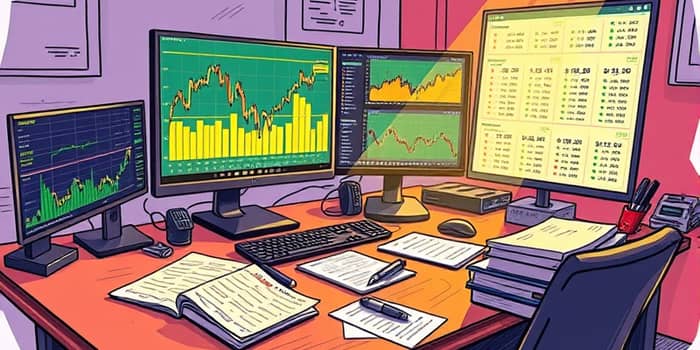
Building a personalized stock watchlist can transform your approach to investing, guiding your decisions with clarity and purpose. This comprehensive guide will help you design, refine, and leverage a powerful watchlist to pinpoint the most promising market opportunities.
Understanding the Core Concept of a Watchlist
A watchlist is more than a list of tickers—it is a curated collection of securities you monitor closely. By blending fundamental health checks and technical signals, you gain a holistic view of each candidate’s potential.
Instead of sorting through thousands of stocks every day, a well-defined watchlist lets you save time and focus on the names most aligned with your strategy, whether you’re hunting growth stars, value bargains, or dividend growers.
Benefits and Purpose
Creating a watchlist yields multiple advantages that elevate your investment process:
- Provides consistent, objective analysis by filtering based on measurable criteria
- Helps avoid emotional decision-making and impulsive trades
- Enables easy comparison across sectors and styles
- Tracks performance metrics to refine your approach over time
- Supports multiple strategies like momentum, GARP, or dividend growth
Step-by-Step Guide to Building Your Watchlist
Follow these six structured steps to assemble and manage your watchlist effectively.
- Define your trading or investing style: Decide if you’re a day trader, swing trader, or long-term investor. This choice dictates volatility tolerance, holding periods, and metric focus.
- Establish selection criteria: Choose both fundamental and technical filters. A target of 15–50 names keeps your list manageable for thorough analysis.
- Screen and select stocks: Use screening tools to apply thresholds—P/E ratios, growth rates, moving averages. Understand each business model and its competitive edge.
- Organize and categorize: Group by sector, market cap, style, or valuation proximity to create sublists for faster insights during market shifts.
- Add notes and track metrics: Record your buy thesis, target prices, and removal triggers. Monitor financials, analyst estimates, and insider activity.
- Review and refine regularly: Perform daily checks on price and technical indicators, then deep monthly reviews to remove underperformers and insert new candidates.
Key Screening Metrics for Fundamental Analysis
Fundamental screening filters for valuation, profitability, growth, and financial health. Below is a summary table with common thresholds to kickstart your research.
Each metric highlights a distinct dimension of a company’s financial profile. Combining them ensures you avoid one-dimensional analysis.
Integrating Technical Criteria
Technical parameters sharpen your entry and exit timing:
Price relative to moving averages indicates trend strength—stocks trading above their 20- and 50-day MAs often exhibit bullish momentum. Watch RSI levels between 30 and 70 for oversold or overbought signals.
Volume patterns validate price moves: a breakout accompanied by a clear volume surge signals genuine buying interest. On-balance volume (OBV) trending upward confirms accumulation.
Spotting chart patterns—breakouts, support holds, hammer candlesticks—can help you anticipate swift moves. Tracking ATR and beta refines stop-loss placement and position sizing.
Organizing and Maintaining Your Watchlist
Maintaining structure and discipline is crucial for long-term success. Consider these practical tips:
- Group names by sector or style for quick rotation during industry trends.
- Use tags or color codes to mark valuation zones: undervalued, fair value, overbought.
- Record performance metrics: hit rate, average gain/loss, time in list.
- Leverage platforms like Stock Rover, TIKR, or TrendSpider to automate alerts and historical comparisons.
By updating your list daily and monthly reviews, you’ll remain agile and responsive to evolving market conditions.
Advanced Tips and Common Pitfalls
Beyond basic screening, consider qualitative factors such as management quality and competitive moats. A strong leadership team and a sustainable advantage often separate winners from also-rans.
Avoid overcrowding your watchlist—quality over quantity matters. Resist adding stocks based on hype; stick to your predefined criteria.
Cultivate discipline: remove names that fail to meet your standards after three review cycles. This prevents stagnation and ensures continual improvement of your watchlist.
Conclusion: From Watchlist to Winning Portfolio
A thoughtfully crafted watchlist is your roadmap through the complexities of the stock market. By combining rigorous fundamental filters with timely technical signals, and adhering to a structured review process, you can uncover high-potential opportunities and make more confident investment decisions.
Embrace the process: define your style, set clear criteria, and refine relentlessly. With dedication and discipline, your watchlist will evolve into a powerful tool, guiding you from research to profitable execution.
References
- https://www.nasdaq.com/articles/how-to-build-a-stock-watchlist
- https://www.stockrover.com/screening-strategies/
- https://tradewiththepros.com/creating-a-trading-watchlist/
- https://www.investing.com/academy/stocks/stock-screener-profitability-and-efficiency-metrics/
- https://www.vantagepointsoftware.com/archives/48645
- https://support.simplywall.st/hc/en-us/articles/10543502387727-Stock-Screener-Key-Features-and-How-to-s
- https://www.tikr.com/blog/how-to-build-an-advanced-stock-watchlist
- https://www.tikr.com/blog/the-10-best-stock-screening-strategies-for-finding-undervalued-stock-ideas
- https://www.fidelity.com/webcontent/ap010098-etf-content/19.11.0/help/research/learn_er_watch_lists.shtml
- https://get.ycharts.com/resources/blog/stock-screeners-101-how-to-analyze-thousands-of-equities-with-ycharts/
- https://www.youtube.com/watch?v=cmXWhRUMFyo
- https://trendspider.com/learning-center/watch-lists-and-universes/