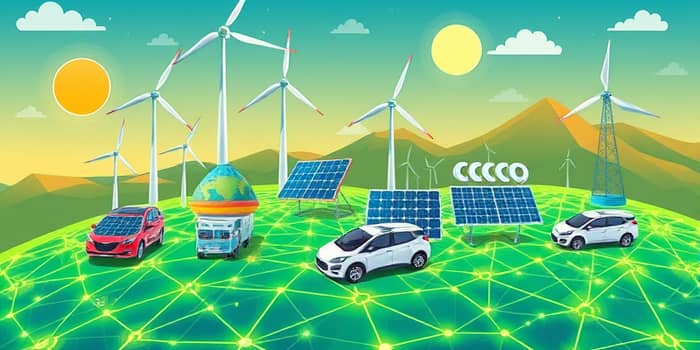
In recent years, the global energy landscape has undergone a profound transformation. What once relied heavily on fossil fuels is now shifting toward a future powered by sustainable resources. Driven by technological advances, policy incentives, and investor confidence, record levels of capital are flowing into clean energy. This article explores the remarkable surge in investment, the regional leaders shaping the transition, sector-specific innovations, and the challenges and opportunities that lie ahead.
Global Investment Surge in 2025
In 2025, total energy investment reached record-breaking $3.3 trillion, the highest level ever recorded. Amazingly, two-thirds of that total—around $2.2 trillion—was directed toward clean energy technologies. Alternative estimates place sustainable energy spending slightly higher, exceeding $2.3 trillion, an 8% increase over 2024. This influx underlines a fundamental shift: for the first time, clean energy outpaces fossil fuels by a significant margin, signaling a new era in global development.
Renewables, grids, energy storage, electric vehicles, and clean fuels form the backbone of this investment wave. Offshore wind farms rose to prominence, while small-scale solar installations democratized power generation for households and businesses alike. As nations grapple with climate change and energy security, this major infusion of capital highlights the growing recognition that a sustainable energy system is both necessary and achievable.
Regional Leaders and Trends
Certain regions have distinguished themselves as clean energy frontrunners, each contributing unique strengths to the global transition. Their achievements illustrate the power of coordinated policy, industry leadership, and private-public collaboration.
- China: Invested approximately $800 billion, adding nearly 300 GW of new renewable capacity, with solar accounting for 240 GW alone in early 2025.
- United States: Directed $378 billion in total energy investment, of which $277 billion targeted clean technologies, boosted by grid upgrades and AI-driven electricity demand.
- India: Achieved record energy investment of $150 billion, including $101 billion devoted to clean energy, underpinning rapid economic growth and electrification goals.
- Latin America: Saw investment decline to $67 billion, a setback that underscores the need for stronger policy frameworks to attract capital.
Despite these successes, low- and middle-income countries collectively received only 7% of clean energy spending, though they represent 40% of the global population. Bridging that gap is essential for an equitable energy transition and global development.
Regional Investment Breakdown
Technological Breakthroughs Driving Growth
The backbone of this transition lies in rapid technological innovation. Solar and wind power lead new capacity additions globally, with solar PV installations surpassing 500 GW cumulative by the end of 2025. Battery energy storage systems (BESS) expanded by 37.4 GW, driven by declining costs and grid-scale deployments. Electric vehicles gained traction, supported by charging infrastructure and consumer incentives.
Grid modernization also plays a pivotal role. Investments exceeding $410 billion worldwide are upgrading aging transmission networks, integrating variable renewables, and enhancing resilience. In the United States alone, grid spending rose nearly 10%, fueled by AI-driven demand forecasts and reliability improvements. These upgrades ensure that clean generation reaches consumers when and where it is needed most.
Challenges and Opportunities Ahead
Despite this momentum, several challenges threaten to stall progress. Policy uncertainty, such as shifting tax credits and trade tariffs, can delay project financing and technology deployment. Some regions face grid bottlenecks and underinvestment, while others risk stagnation as auctions slow or subsidies expire.
- Policy shifts can create investment pipeline uncertainties and increase costs.
- Grid infrastructure in many regions remains over 40 years old, requiring massive upgrades.
- First annual dip in solar additions expected in 2026 due to auction slowdowns in China.
Yet these challenges also present opportunities. Declining battery costs and advanced digital tools offer new ways to balance supply and demand. Corporate commitments to carbon-free power are driving demand from hyperscale data centers, and safe-harbor provisions can accelerate project development. The coming decade will be defined by the ability of stakeholders to navigate complexity and harness innovation.
Charting the Path Forward
As we look beyond 2025, the transition narrative is clear: clean energy is no longer a niche segment but the dominant force shaping the future of power, transport, and industry. To sustain this momentum, stakeholders at every level must act deliberately and collaboratively.
- Governments should provide stable policy frameworks and clear incentives to de-risk long-term investments.
- Utilities and grid operators must accelerate modernization programs to integrate renewables and digital solutions.
- Investors can leverage innovative financing models, such as green bonds and yield-co structures, to support large-scale projects.
- Businesses and consumers alike should embrace energy efficiency measures and electrification of transport to reduce emissions and costs.
Together, these steps will reinforce the virtuous cycle of declining technology costs, expanding deployment, and deepening investor confidence. By fostering collaboration across borders and sectors, we can ensure that the promise of a sustainable, resilient energy system is realized for all.
In conclusion, the unprecedented scale of clean energy investment in 2025 demonstrates that a sustainable future is within our grasp. While challenges remain, the combined efforts of governments, industry leaders, financiers, and civil society can overcome obstacles and unlock transformative opportunities. Now is the time to double down on ambition, harness innovation, and build an energy system that powers prosperity while preserving the planet for generations to come.
References
- https://www.weforum.org/stories/2025/12/global-energy-2026-growth-resilience-and-competition/
- https://www.privatebank.bankofamerica.com/articles/renewable-energy-investments.html
- https://oilprice.com/Alternative-Energy/Renewable-Energy/Clean-Energy-Markets-Face-a-Volatile-Year-Despite-Record-Global-Investment.html
- https://www.wri.org/insights/state-clean-energy-charted
- https://www.bdo.com/insights/industries/natural-resources/2026-natural-resources-energy-predictions
- https://bcse.org/market-trends/top-six-trends/
- https://www.pbig.ml.com/articles/renewable-energy-investments.html
- https://press.spglobal.com/2025-12-09-S-P-Global-Energy-Releases-Key-Clean-Energy-Trends-for-2026-as-AI-Growth-and-Geopolitical-Shifts-Reshape-Global-Energy-Markets
- https://www.spglobal.com/energy/en/news-research/special-reports/energy-transition/horizons-top-cleantech-trends-2026
- https://www.deloitte.com/us/en/insights/industry/renewable-energy/renewable-energy-industry-outlook.html
- https://earth.org/energy-transition-where-are-we-headed-in-2026/
- https://about.bnef.com/insights/finance/energy-transition-investment-trends/