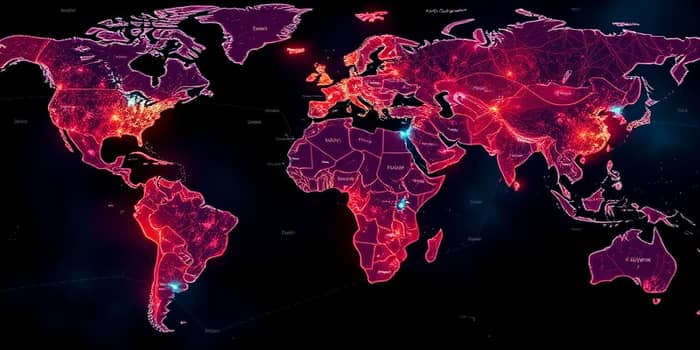
Capital moves around the globe like lifeblood through an organism, fueling growth, innovation, and resilience. As economies become ever more interconnected, understanding these financial currents is crucial for investors, policymakers, and citizens alike.
From direct investments in factories to rapid portfolio trades, each channel plays a unique role in shaping opportunities and risks. This article journeys through the key definitions, recent patterns, regional divides, and forward-looking insights that define the state of global capital flows in 2025 and beyond.
Definition and Types of Capital Flows
At its core, capital flows refer to movements of funds across borders for investment, trade, or business purposes. They act as the veins of the world economy, allocating resources where they can generate returns and transmitting financial shocks in times of stress.
- Foreign Direct Investment (FDI): Long-term stakes in assets or companies, such as building factories or mergers and acquisitions.
- Portfolio Flows: Shorter-term bets on equities, bonds, and other securities, often sensitive to market sentiment.
- Other Investment Flows: Bank loans, deposits, and trade credits that smooth liquidity across borders.
- Private Equity (PE) Flows: Growth capital, buyouts, and exits that reshape industries and corporate ownership.
These types reflect different investor horizons, risk appetites, and strategic goals. While FDI underpins long-term development, portfolio and other flows can surge or retreat rapidly, influencing volatility.
Recent Trends and 2025 Highlights
Global capital flows staged a fragile recovery in 2025, driven disproportionately by financial centers rather than broad-based real economic projects. Total FDI reached $1.6 trillion, up 14%, yet excluding $140 billion in conduit flows through tax-friendly hubs, the increase was a modest 5%.
Merger and acquisition announcements dipped 10%, greenfield project announcements fell 16%, and project finance values also declined by 16%, signaling that headline numbers may mask underlying weakness in new investments.
This dividing line underscores the challenge: while advanced markets attracted surging financial interest, many low-income countries saw stagnation or declines in vital capital inflows.
Regional Patterns and Decoupling
Emerging trends reveal growing divergence between regions. China, once the magnet for both direct and portfolio investments, experienced a post-COVID decoupling, with portfolio flows dampened by changing U.S. policies and other flows influenced by geopolitical tensions.
- North America: Saw a 29% rise in PE buyouts (57% of global total), with megadeals lifting average deal sizes above $900 million.
- Europe: Achieved a 56% increase in FDI, led by Germany, France, and Italy, while PE large deals grew 19%.
- Asia-Pacific: Faced a slight 3% drop in PE buyouts, reflecting slower deal pipelines outside China and India’s robust 6.7% GDP growth.
These patterns highlight that while some markets harness foreign capital to drive innovation and job creation, others must contend with volatility and shifting investor preferences.
Outlook for 2026 and Beyond
Forecasts for 2026 anticipate modest, uneven growth amid key risks. The IMF projects 3.3% global GDP growth, while private forecasters range between 2.7% and 3.1%. Emerging economies could expand at 4.0%–4.6% if reforms deepen and financing channels remain open.
- Upside Drivers: Easing financing costs, surge in AI and tech investments, and targeted fiscal stimulus in major economies.
- Downside Risks: Geopolitical tensions, policy uncertainty, rising protectionism, and incomplete recovery in project finance.
Equity markets may deliver double-digit gains if investor sentiment holds, but concentrated flows into technology and healthcare sectors could expose portfolios to sectoral shocks.
Policy Implications and Strategic Recommendations
To translate capital flows into sustainable growth, policymakers and investors should prioritize real, sustainable investment over transient conduit allocations. This means:
- Bolstering frameworks that reduce regulatory uncertainty and encourage private sector participation in infrastructure and green projects.
- Enhancing cooperation on tax transparency to curb opaque financial center flows that add little local economic value.
- Supporting capacity building in low-income countries to absorb and deploy funds effectively.
Investors, meanwhile, can look beyond headline yields and focus on long-term value by aligning portfolios with climate resilience, digital transformation, and inclusive development. By doing so, they can tap into evolving markets and mitigate concentration risks.
Emerging economies should pursue macroprudential reforms, accumulate reserves, and deepen regional trade agreements to build resilience against sudden stops and reversals. Strengthening governance and transparency will also attract higher-quality FDI and PE flows.
In the words of financial trailblazers, capital should serve the broader mission of human progress. When steered wisely, it can bridge infrastructure gaps, spur technological breakthroughs, and elevate living standards worldwide. Yet without prudent policies and collaborative action, the same flows can leave behind widening rifts between winners and laggards.
Ultimately, tracing the veins of the world economy reveals both the promise and pitfalls of our interconnected age. By embracing strategic foresight, transparent governance, and inclusive investment, we can ensure that the lifeblood of capital sustains growth, fosters innovation, and uplifts communities across the globe.
References
- https://unctad.org/publication/global-investment-trends-monitor-no-50
- https://www.brookings.edu/articles/trends-in-global-capital-flows-to-emerging-markets/
- https://www.mckinsey.com/industries/private-capital/our-insights/global-private-markets-report
- https://home.treasury.gov/news/press-releases/sb0396
- https://www.pwc.com/us/en/about-us/newsroom/press-releases/annual-outlook-2026.html
- https://www.iif.com/Products/Capital-Flows
- https://delphos.co/news/blog/global-capital-trends-2026-an-emerging-markets-outlook/
- https://www.jpmorgan.com/insights/global-research/outlook/market-outlook